Key findings
- Before the repair, it must be clear what kind of cover applies: manufacturer's warranty, the seller's legal guarantee, an extended warranty or a goodwill repair. For work that the manufacturer makes subject to prior authorisation, approval must arrive before the job starts, otherwise the manufacturer will not accept the unapproved scope.
- A claim rests on a technical record in four parts: the symptom, the cause proven by a test, the repair carried out and the result of the final test. A fault code on its own does not justify replacing a part.
- Customer-paid, warranty and insurance work during a single visit belongs in separate lines on the job. Each needs its own approval, and shared dismantling is not charged in full to more than one payer.
- The manufacturer pays according to its own operation codes and standard times, not the workshop's customer price list. The actual time claimed must not exceed the time recorded against the relevant work.
- Replaced parts remain labelled and stored until they are returned or released for disposal. A case is closed only once the payment has been matched to the claim, not as soon as the claim is approved.
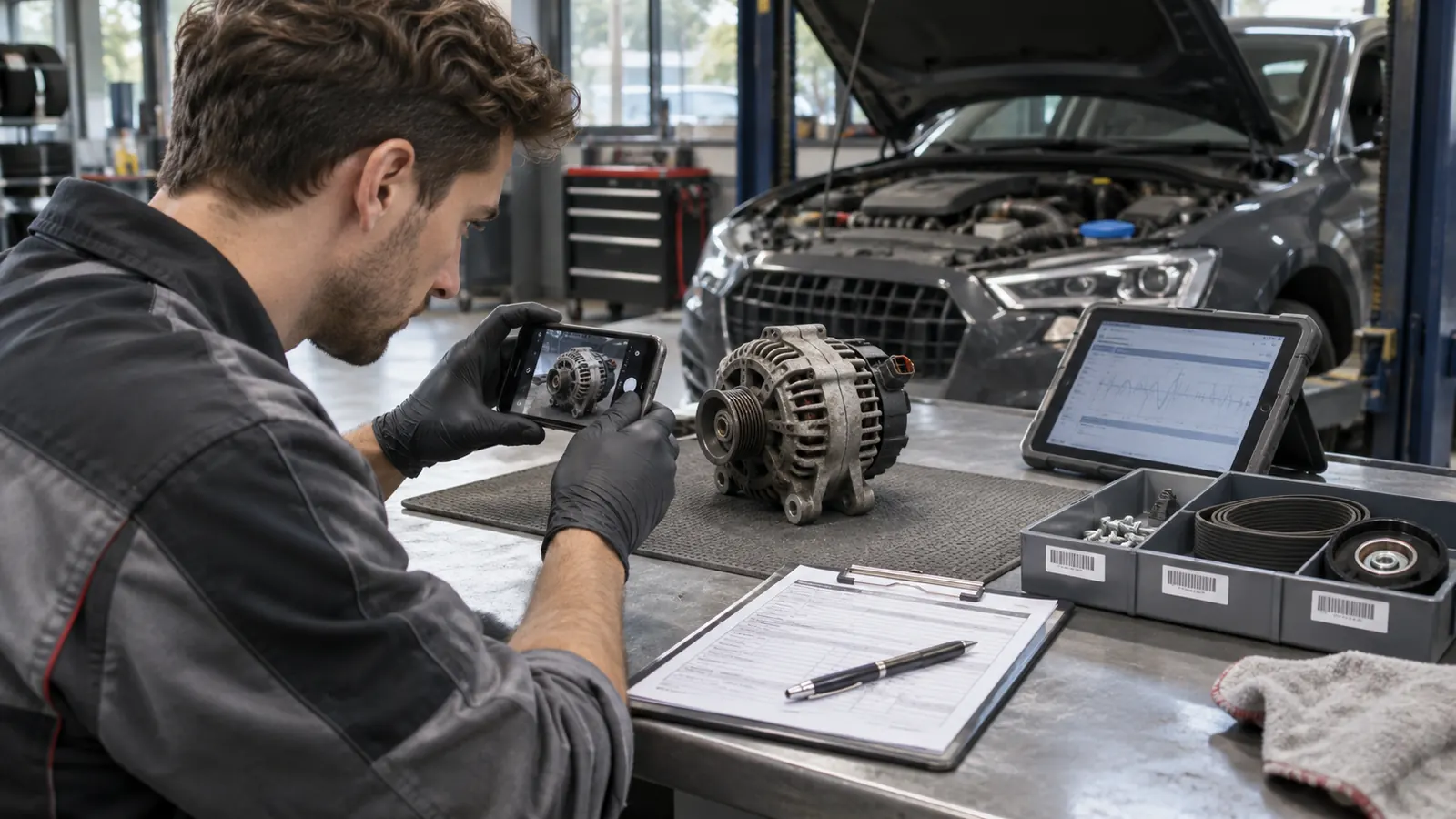
A warranty claim to the manufacturer is the request a workshop submits after a repair under warranty so that the manufacturer reimburses the labour and parts the customer does not pay for. A technically correct repair is only part of the job. The workshop also has to prove entitlement, the cause of the fault and the justification for every item charged. When the documentation is put together only after the repair is finished, photos, measurement results or the original part are missing. The manufacturer then returns or reduces the claim and the costs stay with the workshop. The warranty repair process below links the work of the service advisor, the technician, the warranty administrator and the accounts department.
1. Who pays for the repair: the manufacturer, the seller or another provider?
The first step is to establish on what basis the customer is requesting the repair. Saying "the car is under warranty" does not determine the payer or the approval process.
| Type of cover | What it means | How the workshop handles it |
|---|---|---|
| Manufacturer's warranty | A commercial commitment under the manufacturer's warranty terms | The workshop assigns the repair to the correct warranty programme and follows its rules |
| Seller's legal guarantee for defects | The seller's liability to the consumer under the law | The case is handled against the seller; reimbursement by the manufacturer is a separate, downstream relationship |
| Extended warranty | Contractual cover after the basic warranty ends, provided by the manufacturer or another company | The workshop works with the specific contract, scope of cover, exclusions and approval process |
| Goodwill repair | Voluntary additional cover from the manufacturer beyond its warranty commitment | The split between manufacturer, workshop and customer must be approved before the repair |
Under EU rules, a commercial warranty does not replace the seller's legal guarantee to the consumer. If the manufacturer rejects the claim, the consumer's claim against the seller has not been dealt with. In addition, for goods bought from 31 July 2026, the EU Right to Repair Directive extends the seller's legal guarantee by one year if the consumer chooses repair. For a business customer, the consumer regime cannot be assumed.
Manufacturers also offer extended warranties themselves. In Germany, for example, Volkswagen offers a follow-on manufacturer's warranty that can be added when configuring a new car. The workshop therefore needs to know, for every car, who provides the cover and under what rules approval is given.
Warranty work is the everyday term used in the workshop. For administration, however, what matters is the exact programme and the payer, not the label on the job.
2. How to check entitlement before the repair starts?
The service advisor links the VIN to the date cover started, the mileage, the warranty programme and any service history related to the fault. They also check earlier repairs of the same problem and open technical cases. A repeat fault often requires a different procedure from a first occurrence.
Two questions are dealt with separately:
- Is the fault covered? A warranty may distinguish between components, causes of damage and conditions of use.
- May the workshop start the repair without prior approval? Some work requires approval of the scope, the costs or the technical procedure. Nissan's European warranty manual, for example, requires approval before work starts on repairs subject to prior authorisation.
The approval number, its scope and its conditions belong on the job. Approval for diagnosis does not necessarily cover replacing an entire assembly. If the scope changes after dismantling, the workshop gets the approval extended before continuing.
The Workshop module in Omnetic lets the workshop split the lines of a service job between the customer, warranty and the insurer. It pays to set up this split when the scope of work is defined, so that it is clear from the outset who pays for each line.
3. What must the documentation for a warranty claim to the manufacturer contain?
A usable technical record links the symptom, its cause and the repair carried out. Nissan's European manual is one example that requires this structure. A record reading "engine warning light – sensor replaced" explains neither why the workshop replaced the sensor nor how it verified the result of the repair.
| Part of the record | What it should capture | Example from the workshop |
|---|---|---|
| Symptom | What the customer notices and under what conditions | On a cold start the warning light comes on and the engine runs unevenly |
| Diagnosis and cause | Tests, results and the link to the faulty part | Measurements following the diagnostic procedure confirmed a sensor fault; the wiring passed the prescribed test |
| Repair carried out | The repair and any follow-up operations | Sensor replaced and prescribed adaptation carried out |
| Result | How the workshop confirmed the fault was fixed | Final test under the same conditions without the original symptom |
Depending on the nature of the repair, the record should include:
- the diagnostic report, including fault codes and the freeze frame data stored when they occurred;
- measurement results and the diagnostic procedure used;
- photos of the damage, the location of the fault and the part identification;
- a reference to a technical bulletin or communication with the manufacturer's technical support;
- identification of the parts fitted and removed;
- a record of the final test.
Photos are taken before and during dismantling. For a leak, they must show the point of leakage before cleaning; for a damaged connector, its original condition. A close-up without context is as unhelpful as a wide shot in which the fault cannot be seen.
A fault code is a pointer for diagnosis, not proof. The same symptom can be caused by the component itself, its power supply, the wiring or another fault in the system. The claim therefore has to explain the link between the test result and the repair being charged.
4. How to split one visit between several payers?
A single service job may include a warranty replacement of a component, paid maintenance and accident repair covered by an insurer. Each group needs its own labour and parts lines, its own approval and a clear financial settlement.
| Situation | Correct split |
|---|---|
| Warranty repair and scheduled maintenance in one visit | The manufacturer pays for the accepted repair, the customer for the maintenance ordered |
| Accident repair and an unrelated manufacturing defect | The insurance and warranty parts have separate causes, documentation and invoicing |
| Goodwill repair with contributions from several parties | The shares of the manufacturer, workshop and customer match the split approved in advance |
| Diagnosis reveals a fault outside the cover | Further work follows the scope that the customer has approved and will pay for |
A shared labour operation cannot be charged in full to more than one payer. If dismantling serves several repairs, the way it is split must reflect the reimbursement rules and the work actually done.
Paid continuation of diagnosis or repair needs a scope and price agreed with the customer in advance. Without such an order, the cost of the work usually stays with the workshop if the manufacturer rejects the claim.
5. How much will the manufacturer reimburse and how to work with standard times?
Warranty reimbursement consists of the accepted labour operations, parts and other items that the manufacturer's programme allows. The manufacturer pays according to its own rules for labour and parts; the workshop's customer price list plays no part in calculating the reimbursement.
Three figures are kept separate for labour:
| Figure | What it is used for |
|---|---|
| Time worked | Shows the workshop's cost of the work done |
| Manufacturer's standard time | Sets the time allowed for the labour operation |
| Time accepted in the claim | Records the scope the manufacturer has accepted for payment |
For a repair with a standard time, the workshop uses the correct operation code and permitted combinations. Overlapping dismantling is not claimed again as a separate full operation.
Additional diagnosis and work with no applicable standard time follow a separate manufacturer procedure. The record must show what the technician did, why it was necessary and how long it took. Nissan's rules, for example, do not allow the actual time claimed to exceed the time recorded against the relevant work. Time is therefore recorded as the work progresses, not estimated afterwards.
The Time-keeping module in Omnetic records time worked directly against the job and its lines. For every warranty job, the workshop can see whether the hours sold match the hours worked.
The economics of a warranty repair also include work that the manufacturer does not pay for separately. The German motor trade association ZDK counted administrative requirements, trained staff and storage of replaced parts among the costs of warranty repairs. If these activities are left out of cost tracking, even an approved claim can lose the workshop money.
6. How to store and return replaced parts?
A removed part is evidence for the repair. From the moment the technician takes it off the car, it must be possible to trace which VIN, job and claim it belongs to.
The operating procedure specifies:
- labelling the part with the job or claim number, the vehicle identification and the date of removal;
- storage in a separate area for warranty parts;
- protection against mix-ups, damage and loss of evidence of the fault;
- a responsible person who tracks return requests;
- a record of the part being shipped or released for disposal.
The retention period, packaging method and the point at which disposal is allowed are set by the manufacturer's rules. Approval of the claim and release of the part are often two different moments.
A warranty part required for inspection and a returnable core in an exchange programme are not the same thing. They differ in the reason for return, the recipient and the financial settlement. If they are confused, the part ends up in the wrong place or is missing when the claim is checked later.
7. How are warranty repairs invoiced and claims closed?
Before the claim is submitted, the warranty administrator compares the technical record with the operations, parts and approval being charged. Every line must be linked to the fault described and the work carried out.
Checklist before submission:
- The VIN, mileage and key dates match the job.
- The type of cover and the payer are correctly assigned.
- The description contains the symptom, cause, repair and test result.
- The required approval and attachments are included.
- Labour operations do not overlap and the parts match the repair.
- Customer and insurance lines are not in the warranty claim.
- Removed parts can be traced.
After submission, both the status of the claim and the person responsible are tracked. "Submitted" does not mean "approved", and "approved" does not yet mean "paid".
| Status | Follow-up work |
|---|---|
| Ready to submit | Completing and final checking of the claim |
| Submitted | Monitoring receipt and the manufacturer's response |
| Returned for additional information | Correcting the flagged shortcomings within the manufacturer's deadline |
| Approved or reduced | Comparing the items claimed with those accepted |
| Financially settled | Matching the payment or credit to the claim |
Deadlines for submission, additional information and review vary by programme, so every open case has its own next-step deadline in the records.
When a claim is reduced, administrative reasons are separated from technical ones. A missing attachment is resolved by adding it; an unaccepted link between the part and the original fault by technical justification. The case is closed only once the difference between the amount claimed and the amount accepted has been resolved.
8. How do recalls fit into the process?
When checking the VIN, the workshop tracks open recall and service campaigns separately. They are carried out according to the manufacturer's own instructions: the scope of the work, the parts used, how labour is claimed and confirmation of completion.
The fault the customer came in with and an open campaign may be two unrelated matters. Carrying out the campaign does not replace diagnosing the complaint, and a standard warranty claim does not replace recording the campaign as completed. Where the work overlaps, it is claimed in a way that avoids double charging.
Watch out: why are claims returned or reduced?
The manufacturer can deduct the workshop's costs retrospectively, even after payment, if the link between the work charged and the original complaint was not documented. The following mistakes therefore cost money not only at submission but also later on.
| Mistake | Risk for the workshop | Prevention |
|---|---|---|
| The repair started before the required approval | The manufacturer does not accept the unapproved scope | Approval is on the job before work starts |
| The documentation only describes the part replacement | There is no proof of the cause of the fault | The technician records the test, the result and the link to the repair |
| The work charged is unrelated to the complaint | The line is reduced or deducted later | Every operation follows from the problem and findings described |
| Time worked is not recorded against the work | The claim has no support in the records | Time is recorded against the line as the work progresses |
| The removed part was disposed of too early | The workshop cannot meet the inspection requirement | The part is released only according to the claim status and retention rules |
| Nobody is responsible for the claim | The deadline for additional information or review is missed | Every open case has an owner and a next deadline |
Approval of a claim does not end the possibility of a later audit. Technical documentation, time records and parts records therefore stay together for the entire period set by the manufacturer's rules.
The service manager needs to see repairs completed in the workshop separately from claims not yet submitted, returned or unpaid. Otherwise the administration hides behind a closed service job and the cost remains without revenue.
Omnetic links the warranty job, time and invoicing
In day-to-day operations, a warranty case is split between the service job, technicians' time records, the parts warehouse and the manufacturer's portal. Omnetic runs these steps on a single shared record instead of separate spreadsheets and re-keying data:
- Workshop manages the service job from quotation through vehicle check-in, parts and planning to invoicing. It splits the lines of a single job between the customer, warranty and the insurer, so the warranty claim contains only what belongs in it.
- Time-keeping records time worked against the job and its lines. The workshop sees the difference between hours worked and hours sold and has time documented for every piece of work.
- Omnetic DMS Core holds the shared record of the vehicle, customer, jobs and money, so data is not re-keyed between modules.
Existing systems, such as the manufacturer's portal, can be connected via the open platform; the Omnetic group has 64 certified manufacturer integrations. The availability of a specific integration is confirmed for each market and brand.
Book an Omnetic demo focused on managing warranty jobs, splitting payers and recording time worked.
Related articles
- Vehicle check-in at the workshop: active reception, walkaround with the customer and condition report
- Motor Vehicle Block Exemption Regulation: the rules for dealers and workshops until 2028 and the status of the review as of November 2026
- Parts stock: how to identify non-moving parts and release tied-up capital
FAQ
Is a warranty repair the same as a warranty service?
No. A warranty repair usually means a repair paid for under the warranty, while a warranty service means scheduled maintenance carried out during the warranty period. Both can take place during one visit, but each has a different purpose and a different payer.
What if the fault does not show up during the workshop visit?
The record captures the conditions under which, according to the customer, the fault appears, the tests carried out and the result showing no confirmed fault. A recording of the symptom by the customer, such as a video, and stored diagnostic data help. Replacing a part as a precaution without technical justification is a direct route to a rejected claim; for a recurring fault, the manufacturer's technical support is the right next step.
Does an accepted warranty repair also mean a paid-for courtesy car?
Not automatically. A courtesy car, towing and other services have their own programme rules and their own approval. The claim should include only items for which cover exists.
Who should be responsible for the whole case?
A single case owner, usually the warranty administrator or a designated service advisor. The technician is responsible for the technical record, the stores for the traceability of parts and the accounts department for matching the payment. The owner makes sure the case does not stall between these steps.
Sources
- https://europa.eu/youreurope/business/selling-in-eu/consumer-contracts-guarantees/consumer-guarantees/index_en.htm
- https://commission.europa.eu/document/download/2d443b31-dc2a-4e54-a9ec-5fbb61c895e9_en?filename=2024_07_18_QA_Right2repair_FINAL.pdf&prefLang=pl
- https://www.volkswagen.de/de/angebote-und-produkte/versicherungen/garantien.html
- https://eu.nissan.biz/enews/nissanows/EWPPM_610/FRA/EWPPM.pdf
- https://d-nb.info/1044349557/34
- https://www.autohaus.de/nachrichten/werkstatt/autohaus-3-2014-zdk-hilft-handel-bei-garantieverguetung-2737992
- https://www.omnetic.com/workshop
- https://www.omnetic.com/time-keeping
- https://www.omnetic.com/dms-core
- https://www.omnetic.com/faq