Key findings
- The inspection, servicing, routine mechanical repairs and the final quality check belong in the dealer's own workshop, provided it has capacity reserved for reconditioning. Paintwork, bodywork repairs, intensive valeting and work beyond the workshop's capacity are worth outsourcing to external suppliers.
- Compare an external quote with the full internal cost: labour, parts, materials, transport, coordination and rectification work. In 2025, the French Bodemer group set its Bruz centre a target of keeping average reconditioning costs below €1,000 per car, including transport.
- The scope of reconditioning and the cost limit come from the inspection at appraisal. Additional work is approved by the used car manager before it starts.
- One person in the business is responsible for the whole car, even when the in-house workshop, a paint shop and an external valeting company all work on it. Only the final quality check releases the car for advertising.
- In Omnetic, CarAudit turns inspection findings into reconditioning tasks, and Planner includes the reconditioning of cars for sale in the workshop plan.
Used car reconditioning connects buying in, the workshop and used car sales. The result should be a car with no technical faults, a tidy appearance and complete documentation for the advert and handover to the customer. This work is not paid for by an end customer, so in the workshop it often gives way to jobs that generate revenue. On top of that, a gap often opens up between what the appraiser found, what the used car manager ordered and what the workshop eventually did. Choosing between the in-house workshop and external suppliers is therefore not just a question of price. It is also about capacity, handovers between teams, approving costs and signing off the result.
In-house workshop or external supplier: how to split the work
For a dealership with its own workshop, the default model is a combination of both routes. The inspection, defining the scope and final sign-off of the car stay in-house. The work itself is split according to equipment, expertise and available capacity.
The in-house workshop is best placed to handle servicing and mechanical repairs, because it knows the brand's history and does not have to move the car anywhere. Paintwork, dent repairs and intensive interior valeting are taken on by specialist suppliers if the business has no paint shop or valeting bay of its own. External capacity also helps when more cars arrive at once from buying in or part-exchanges than the workshop can handle.
| Aspect | In-house workshop | External supplier |
|---|---|---|
| Costs | Visibility of labour and parts; costs also include technicians' time, equipment and overheads | Price according to a quote with a defined scope; transport, handover and coordination come on top |
| Capacity | Reconditioning competes with customer jobs for technicians and bays | Takes pressure off the in-house workshop if the supplier has a confirmed pick-up and completion date |
| Time | No transfers; turnaround depends on the capacity the workshop actually reserves for reconditioning | Transfers and waiting for the supplier's next free slot add time |
| Continuity of work | Easy handover between diagnosis, repair and inspection | Every transfer means handing over the car, the keys and the scope of work |
| Quality control | The manager deals with findings as they arise, directly with the technician | The result is signed off against the order and the agreed standard |
| Additional faults | Quick agreement with the used car manager | A fixed procedure is needed: photo of the finding, price and approval before continuing |
| Responsibility | The relevant department is responsible for the work | The supplier is responsible for the work ordered, but the dealership still manages the whole reconditioning process |
An in-house workshop makes sense where it has the necessary equipment and capacity allocated to reconditioning. Reconditioning "when there is time" has no reliable deadline. An external job without a booked slot, on the other hand, merely moves the waiting outside the dealership gates.
Combined models
There are several arrangements between the in-house workshop and outsourcing everything. On the French market, the options cited for used car reconditioning include central reconditioning centres serving several branches, body shops shared by several sites, subcontracting and mobile services on the dealer's premises. Suppliers offer individual operations as well as taking over the entire reconditioning process. Germany's Autohaus Wolf combines in-house reconditioning with a partner workshop. The French Bodemer group's centre in Bruz outsourced specialist operations to external suppliers. In every variant, the inspection, the decision on scope and the sign-off of the finished car remain in-house.
What used car reconditioning involves
The scope of reconditioning is based on the car's condition at appraisal. The same package for every used car leads either to overlooked faults or to unnecessary work. Technical faults and safety always take priority over appearance.
| Area of reconditioning | What it includes | What is recorded before passing it on |
|---|---|---|
| Technical inspection | Diagnostics, road test, checks of the chassis, brakes, leaks and functional equipment | Findings, photos and a list of repairs |
| Servicing and mechanical repairs | Maintenance according to the history and the manufacturer's specifications, rectification of faults found | Work carried out, parts used and updated service records |
| Tyres and wheels | Tyre condition, wheel damage and uneven wear | Repair or replacement; for unusual wear, also rectifying the cause |
| Body and paint | Dents, SMART repairs and paintwork | Approved scope and photos before and after the repair |
| Valeting and cosmetics | Interior, boot, glass, exterior, odour removal and surface treatment | Dry, clean interior, with no faults concealed |
| Photos and documents | Sales photos, equipment check, keys, service records and other documents | Complete documentation for an accurate advert and for handover |
An unevenly worn tyre is not just an item to replace. It often points to incorrect wheel alignment or worn suspension. Similarly, an odour in the interior requires the cause to be removed. Simply masking the smell passes the problem on to the next owner, and it comes back as a complaint.
CarAudit from Omnetic records findings during the inspection with photos and damage on a body diagram. The report is saved to the vehicle record, and the findings can be turned into reconditioning tasks. Buying in thus hands the workshop a precise brief instead of a note saying "prepare for sale".
How far should cosmetic reconditioning of a used car go?
Cosmetic reconditioning of a used car removes a neglected appearance and approved minor damage. It must not create the impression that the car is in better technical condition than it is. Every finding therefore has one of three outcomes: repair it, leave it and describe it in the advert, or refer it for expert assessment.
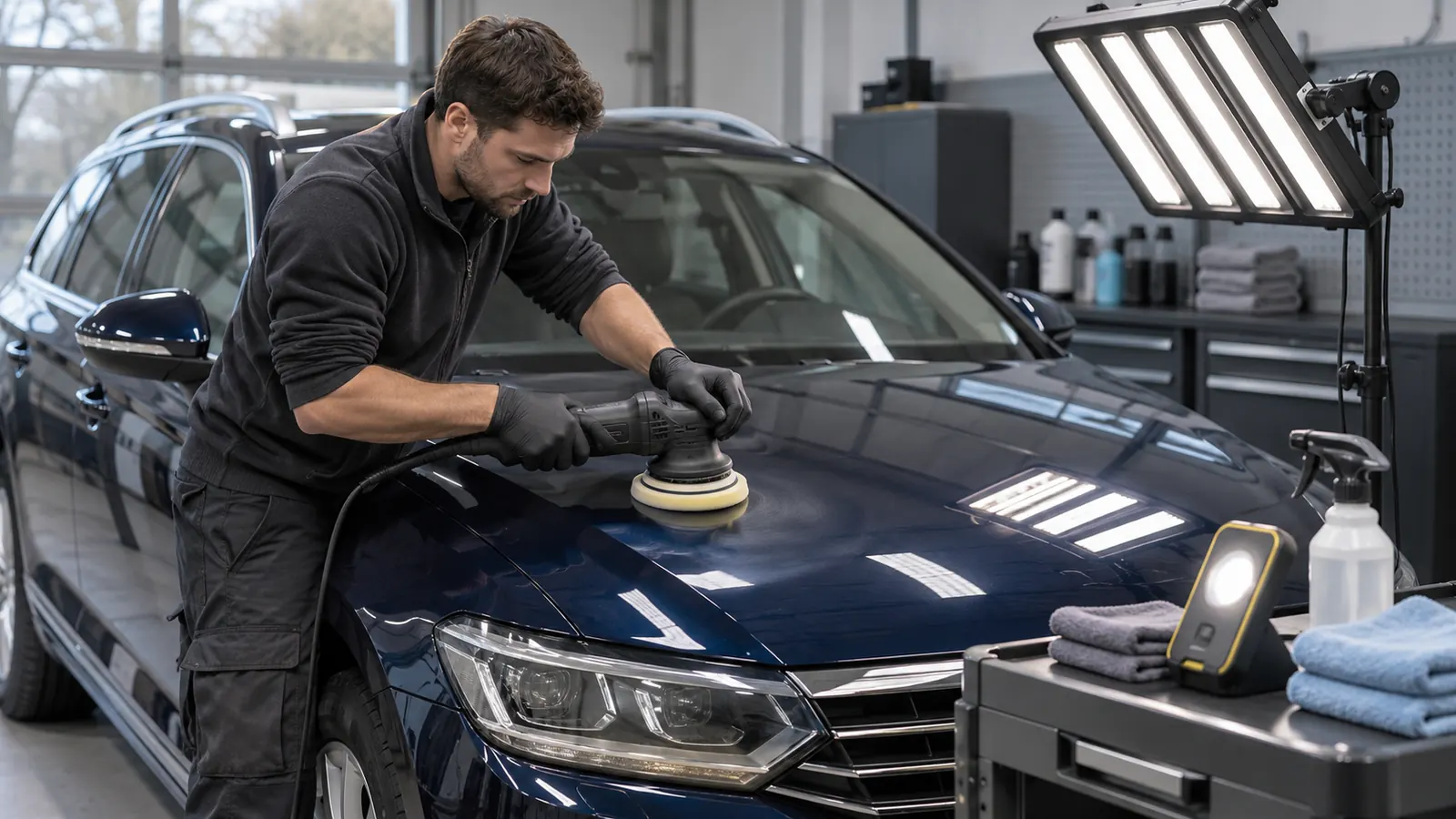
Light surface scratches can usually be dealt with by polishing. Deeper paint damage needs a paint shop and a different budget. With a wet carpet, the water leak must first be repaired and the interior dried. Only then does final valeting make sense.
How to compare the costs of in-house and external reconditioning
In-house reconditioning is not free just because the technician and the bay are already there. The cost of the car includes time worked, parts, consumables and external operations. An hour a technician spends on a stock car is also an hour the workshop does not sell to a customer.
An external invoice, on the other hand, does not contain the full cost of reconditioning. Transfers, handing over the car, additionally approved work or repeat valeting after the car returns from the paint shop are added to it.
| Cost item | What to include in the comparison |
|---|---|
| Internal labour | Time worked, costed at a single internal cost rate |
| Parts and materials | Parts issued and materials used, minus returns |
| External labour | The scope ordered plus approved additional work |
| Logistics | Transport between sites and suppliers, handover and collection |
| Rectification work | Repeat work and who bears its cost |
| Total reconditioning | The sum of all items assigned to one car |
An example of budget control comes from France: in 2025, the Bodemer group's centre in Bruz had a target of keeping average reconditioning costs below €1,000 per car, including transport. Such a limit only makes sense if it covers all the items in the table. A budget that counts only the repair invoice and leaves out logistics or internal labour makes reconditioning look cheaper than it really is.
Apart from money, the in-house workshop has capacity constraints. When reconditioning needs a technician who is already scheduled for customer repairs that have been promised, management has to set the priority, and the car either gets a new fixed date or goes to an external supplier. Repeated postponement without a date makes in-house reconditioning the most expensive option.
How to manage reconditioning from appraisal to advert
1. Turn the inspection into a work list
Each finding has a description, a photo where it helps, and a proposed solution. For an unclear fault, the brief should start with diagnosis, not a repair promised in advance.
The list separates technical faults, maintenance, cosmetics and missing documents. The documents can then be obtained in parallel with the mechanical repair rather than waiting for it to be finished.
2. Approve the scope, budget and person responsible
The used car manager approves the commercial scope of reconditioning and the cost limit. The workshop determines the technical procedure. One designated person is then responsible for the whole: deadlines, suppliers, open findings and releasing the car for advertising.
If an additional fault is found, work stops to the extent that a new decision is needed. The basis for approval is a photo of the finding, a proposed solution and the impact on costs. An order to "do whatever is needed" means losing control of the final bill.
3. Sequence the work according to dependencies
Mechanical and bodywork come before final valeting and photography. Otherwise you pay for repeat washing, transfers and new photos.
The plan also includes parts and supplier deadlines. A car waiting for a part should not block a workshop bay. Without a confirmed paint shop date, no completion date can be promised for the whole reconditioning. Planner in Omnetic assigns work to technicians according to their skills and availability, takes account of parts in stock and the reconditioning of cars for sale, and adjusts the plan in the event of delays. The workshop foreman decides the final order.
4. Hand over external work with clear terms
The order for the supplier contains the scope, the price or how it will be determined, the deadline and the rules for additional work. The handover includes a record of the car's condition and the keys and accessories handed over.
In regular cooperation, a reference for the required quality helps: photos of an acceptable repair, the scope of valeting, requirements for the car's condition after painting. A mobile specialist can carry out some operations directly at the dealership and save transfers. Their work nevertheless goes through the same approval and sign-off as a job carried out off site.
5. Sign off the result and release the car for sale
Completed work is signed off against the approved list. For a mechanical repair, sign-off includes a function test; for bodywork and cosmetics, a check of the result and of any new damage.
Used car reconditioning is closed only by the final quality check. Completed orders do not yet mean a car that is ready: a service record, a document or sales photos may still be missing.
A uniform standard is also reinforced by external audits. In its Renault renew Refactory certified programme, Renault uses SGS to audit whether reconditioning processes meet the programme's standards.
6. Close off time and actual costs per car
Five figures are enough to manage reconditioning:
- Total reconditioning time: from taking the car into reconditioning to releasing it for advertising.
- Time worked: labour assigned to individual operations.
- Waiting by cause: approval, parts, in-house workshop, supplier or documents.
- Approved and actual costs: the difference broken down by item.
- Returned work: shortcomings found at the final quality check and who caused them.
Long reconditioning with little work points to waiting and handovers. A budget exceeded because of new findings points to a weak inspection at appraisal. Time-keeping in Omnetic records time worked directly against the job and its lines, so you can see for every car how much in-house labour went into reconditioning.
Until the external invoice arrives, the expected cost remains visible on the car. Reconditioning can be closed off financially only once all items have been entered.
Watch out
- Reconditioning has no reserved capacity. The in-house workshop repeatedly pushes it behind customer jobs. A fixed slot in the workshop plan helps, along with an external supplier for work the workshop cannot complete on time.
- Suppliers receive different briefs. The appraiser orders valeting, the salesperson adds polishing, the workshop a repair. Only one approved work list is binding.
- Cosmetics conceal a fault. Erased fault codes or a masked odour do not solve the cause. The repair outcome must be recorded for every technical finding.
- The cheapest quote contains less work. Only quotes with the same scope, handover quality, transport and procedure for shortcomings can be compared.
- Nobody signs off the whole. The individual suppliers have finished, yet the car is still not ready. Responsibility for releasing it for advertising remains within the dealership.
Omnetic connects the inspection, the workshop and used car sales
Most information is lost during reconditioning between buying in, the workshop and sales, especially when each department works in a different system or spreadsheet. In Omnetic, all modules work on a single shared record of the vehicle, jobs and money in DMS Core, so data is not re-keyed between departments.
- CarAudit captures the car's condition during inspection, including photos and a damage map, turns findings into reconditioning tasks and passes the car's condition to the valuation in the Price Report module.
- Workshop manages the workshop side of reconditioning as a job, from quotation through parts and planning to invoicing.
- Used Car Sales manages the used car from buying in through reconditioning and advertising to handover and accounting.
In-house and external work thus remain in one managed process, and their sequence does not have to be pieced together from emails. An Omnetic demo can walk through a car's journey from inspection through reconditioning to advertising in the day-to-day operations of your dealership.
Related articles
- Workshop planning: how to replan when repairs are delayed, a technician is absent or parts are missing
- Vehicle handover to the customer: from preparation to follow-up contact
- Selling a car on consignment or buying it in? Differences in liability, contracts and records
FAQ
Can a car be advertised before reconditioning is finished?
Yes, provided the advert accurately describes the car's condition and states which work is still to be done. The date of handover to the customer is based on the confirmed reconditioning plan. Photos taken before the repair must not look like pictures of the finished result.
What else does reconditioning a used electric car involve?
Only technicians with the appropriate qualifications and equipment may work on the high-voltage system. Reconditioning also includes checking charging and the condition of the cables handed over with the car. Information on the state of health of the traction battery should be based on diagnostics or a test, not on the range shown on the instrument panel.
How should a second set of wheels and accessories be recorded?
Each set of wheels and each component handed over belongs to a specific car, is labelled and has its storage location recorded. For wheels, their condition is recorded too. The salesperson then knows what can be stated in the advert and what needs to be ready at handover.
Should the workshop charge the used car department for reconditioning with a profit mark-up?
That is a matter of internal management, but both departments need to know which figure they are working with. The cost rate is used for the car's costs and for comparison with an external quote. If the workshop charges reconditioning with a mark-up, the workshop looks more profitable, used cars look worse and external quotes look better value than they are.
Sources
- https://www.autohaus-wolf-pfalz.de/de/ueber-uns/
- https://auto.zepros.fr/sourcing/reconditionnement-groupe-bodemer-veut-maitriser-ses-couts
- https://journalauto.com/distribution/voitures-doccasion-les-usines-de-reconditionnement-restent-un-dilemme/
- https://fr.renew.auto/refactory-certified.html
- https://www.cebia.cz/pruvodce/jak-zkontrolovat-stav-ojeteho-auta
- https://www.omnetic.com/dms-core
- https://www.omnetic.com/caraudit
- https://www.omnetic.com/planner
- https://www.omnetic.com/time-keeping
- https://www.omnetic.com/workshop
- https://www.omnetic.com/used-car-sales