Key findings
- European directives require employers to provide adequate training, specific training for work involving specific risks and free personal protective equipment. Qualification levels and their names are set by national regulations and standards, such as Germany's DGUV Information 209-093, the French habilitation électrique, Austria's OVE R19 and the Dutch NEN 9140.
- Qualifications are graded according to the type of work. For non-electrical tasks, an instructed person is sufficient; making the high-voltage system safe and repairing it requires a specialist, and live working requires specific authorisation.
- In Germany, training for the 2S specialist level takes at least 16 teaching units, eight of them practical. Safety instruction is repeated at least once a year. In France, the habilitation is reviewed every year and refresher training is recommended every three years.
- In Austria, the safety condition of an incoming vehicle with a high-voltage system must be assessed by someone with knowledge at least at HV2 level. In the Netherlands, the decision to quarantine a battery is taken by the person responsible for the work (ev-WV).
- Jobs on electrified vehicles may only be assigned to technicians with the appropriate authorisation. Planner in Omnetic assigns work according to technicians' skills and availability, so work on the high-voltage system does not end up with an unauthorised member of staff.
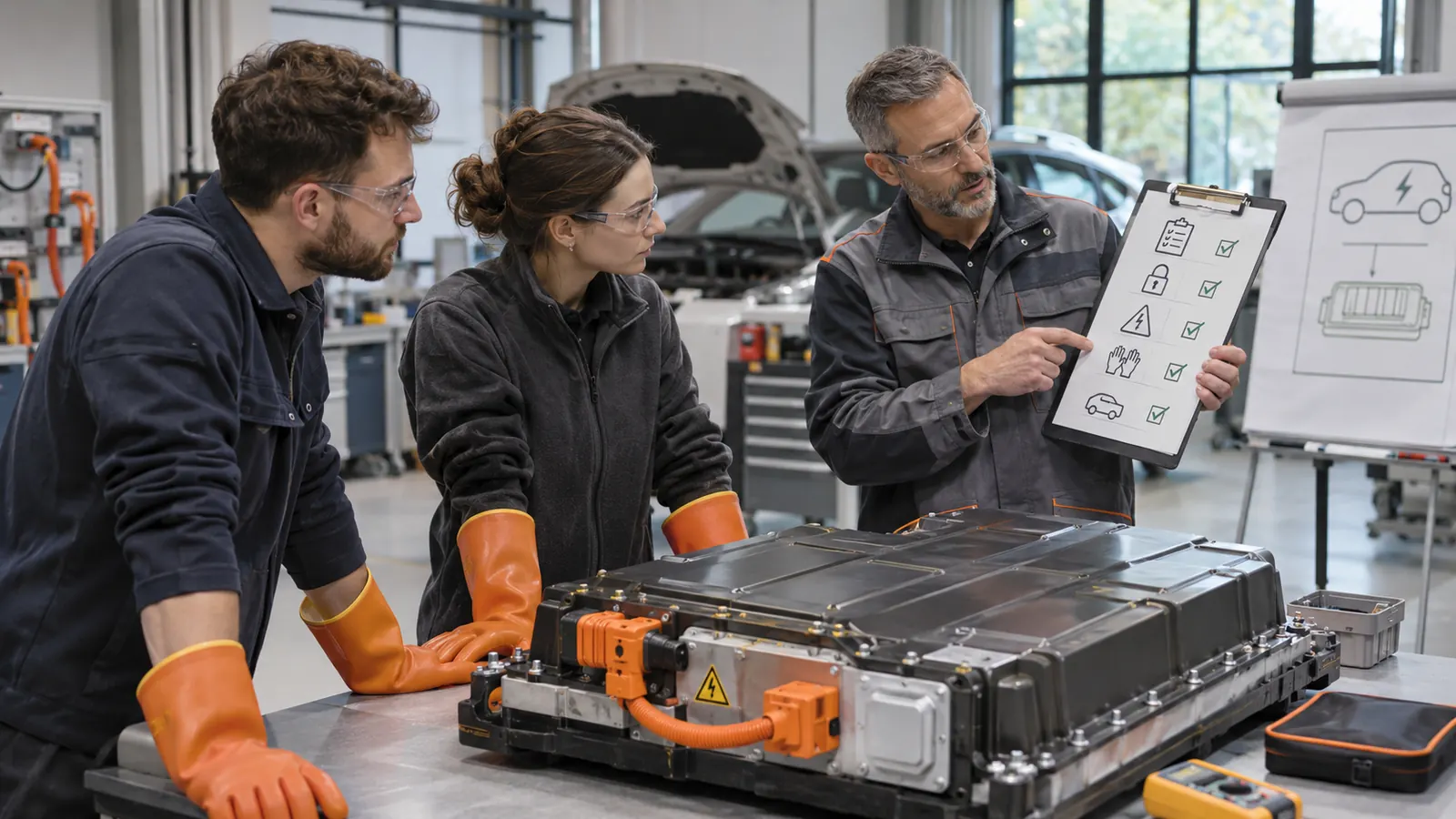
Electric cars, plug-in hybrids and hybrids have a high-voltage system, where routine mechanical repairs sit alongside the risk of electric shock. Qualifications for working on electric vehicles therefore concern not only the technician repairing the battery. They also concern vehicle check-in, preparation, washing, recovery and workshop layout. European law sets a common framework for occupational safety, but each country regulates the specific qualification levels differently. For workshop management, this creates a practical task: linking staff training, their authorisations and the individual steps of a workshop job.
What European law governs and what is left to member states
The European directives on occupational safety and health (OSH) place obligations on the employer. You will not find technician qualification levels in them. These are set by national regulations, technical standards and the guidance of accident insurance institutions.
| European legislation | Employer's obligation | Impact on the workshop |
|---|---|---|
| Framework Directive 89/391/EEC | Provide every employee with adequate OSH training | The content of the training must match the work and risks of the individual employee |
| Directive 2009/104/EC | Provide specific training for work equipment involving specific risks | Experience with mechanical repairs does not replace preparation for high-risk activities |
| Directive 89/656/EEC | Provide appropriate personal protective equipment free of charge | Protective equipment is paid for by the employer, not the technician |
National documents do not have the same legal status. A law, a technical standard and an accident insurer's guidance are not interchangeable. A dealer group with branches in several countries can therefore have a common operating standard, but it sets authorisations according to local rules. A German qualification designation does not automatically transfer to a site abroad. Even the German Social Accident Insurance (DGUV) explicitly requires businesses that use its procedures abroad to comply with the laws and regulations there.
Which electric vehicle qualification matches which tasks
Authorisation for work on electric vehicles is derived from the activity, not from the fact that the car has an electric drive. Washing an undamaged car, replacing a component of the high-voltage system and taking measurements on live parts are three different situations. The main risks are electric shock and arc flash, plus a thermal event in the case of a damaged battery.
A typical grading looks like this. Individual countries use their own names for the levels.
| Type of work | Typical level of training | Limits of the activity |
|---|---|---|
| Washing, preparing, moving or recovering an undamaged vehicle | Instruction appropriate to the task | No work on the high-voltage system; a damaged vehicle changes the working conditions |
| Routine mechanical maintenance outside the high-voltage system | Instructed person according to local rules and the work procedure | No work on high-voltage components |
| Making the high-voltage system safe and working on the de-energised system | High-voltage specialist with authorisation | Safe isolation of the system and the subsequent work procedures |
| Opening and repairing the traction battery | Specialist training for batteries | Disconnecting the battery from the vehicle does not remove the electrical risks inside the battery |
| Work on accessible live parts | Special qualification and authorisation for live working | The strictest requirements for procedure, workplace and protection of the worker |
This leads to a rule for check-in: an undamaged car in for scheduled maintenance and an accident-damaged vehicle with a damaged underbody are two different types of job. Planner in Omnetic assigns tasks according to technicians' skills and availability and sequences them according to dependencies. Vehicle preparation can thus go to a different member of staff from the one who carries out the work on the high-voltage system. The scope of skills and authorisations is set by the employer.
High-voltage training for mechanics: a comparison of five countries
The overview reflects the situation as of November 2026. The designations used in the individual countries are not interchangeable levels.
| Country | Regulation or standard | Levels and roles | What it means for the workshop | Source |
|---|---|---|---|---|
| Germany | DGUV Information 209-093 | FuP (electrotechnically instructed person), specialist level 2S | Training for 2S: at least 16 teaching units, eight of them practical (for entrants with electrotechnical knowledge from the automotive sector); safety instruction at least once a year | DGUV |
| France | NF C18-550, habilitation électrique | Habilitation for work involving electrical risk; an informed worker without habilitation for non-electrical tasks with no electrical risk | Habilitation reviewed every year, refresher training recommended every three years | INRS |
| Austria | OVE Guideline R19, edition of 1 December 2024 | HV levels; at least HV2 for assessing an incoming vehicle | A person with HV2 knowledge must be available at check-in | OVE, WKO |
| Netherlands | NEN 9140:2024 | Person responsible for the work (ev-WV) | The decision to quarantine a battery is taken by the ev-WV, not by any member of workshop staff | NEN |
| Italy | CEI TS 78-24 | Technical specification for electric and hybrid vehicles, published in October 2026 | A new basis on which Italian workshops set their safe working procedures | CEI |
Germany: specialist training and annual instruction are two different obligations
The German system separates staff who carry out non-electrical tasks (FuP) from specialists who make the high-voltage system safe and work on it. The 16 teaching units for level 2S apply to someone who comes with electrotechnical knowledge from the automotive sector. A mechanic without this foundation needs longer training. Safety instruction at least once a year is in addition to specialist training; it does not replace it.
France: the habilitation is reviewed every year
The habilitation électrique defines which activities involving electrical risk a worker may carry out. A training certificate and the habilitation are therefore not the same thing. It is reviewed every year, and refresher training is recommended every three years. This interval applies to France; it is not a European deadline.
In France, a non-electrical task with no electrical risk may be carried out by a worker without habilitation, provided they have been informed about the electrical risk. Habilitation is therefore not required for everyone who washes a vehicle or prepares it for handover.
Austria and the Netherlands: safety starts at check-in
The Austrian requirement of at least HV2 for assessing the safety condition of an incoming vehicle directly affects shift planning. Someone with this knowledge must be available at the moment of check-in, not only when the vehicle is scheduled for repair.
In the Netherlands, the NEN 9140 work scheme assigns the decision to quarantine a battery to the person responsible for the work (ev-WV). So the location of a damaged or suspect vehicle is not decided by whichever member of staff happens to be looking for a free parking space.
How to reflect qualifications in workshop management
Records of permitted activities, not just certificates
Records that can be used to assign work contain the following for each member of staff:
- training completed and its scope,
- initial professional qualification,
- permitted activities and their limitations,
- date of authorisation and the person responsible,
- the due date for repeat instruction, review of the authorisation or refresher training.
An entry reading "trained on electric vehicles" is too general for assigning work. The workshop foreman needs to know who may carry out non-electrical tasks, who makes the high-voltage system safe and who is authorised for live working.
A job split according to dependencies
A single workshop job often includes making the system safe, a mechanical repair and returning the vehicle to service. Each step can be done by a different person, but the steps must follow on from each other safely. Workshop capacity therefore does not depend only on the number of free mechanics. It also depends on when the specialist who creates safe conditions for further work is available. In the Workshop module, the workshop manages the entire job from quotation through vehicle check-in and parts to invoicing, so for every step you can see what it depends on.
Workplace and equipment according to the activity
Work on vehicle high-voltage systems requires a designated working area, labelling of the vehicle's status, insulated tools, measuring instruments and protective equipment according to the type of work. The employer provides protective equipment free of charge. A single generic "EV kit" does not cover every type of work.
Damaged vehicles outside the normal job flow
With an accident-damaged vehicle, a damaged battery or a suspected abnormal battery condition, the safety assessment takes priority, and the repair date only comes after it. The business needs to define in advance the person responsible, a quarantine parking area, access restrictions and an emergency procedure. A fixed quarantine distance or period does not replace an assessment of the battery's condition.
Training based on the job mix
A workshop focused on routine maintenance needs a different mix of skills from a site that repairs traction batteries. An overview of jobs shows how much work requires specialist isolation of the system and where the workshop depends on a single technician. Training should also cover cover for absences. A specialist who is available for only part of a shift limits the appointments on offer, even if the workshop has free bays.
Watch out
A course instead of an authorisation. A course documents completed training. An authorisation defines which activities the worker may carry out in a specific business.
A de-energised system does not mean a safe battery. Energy remains inside the battery even after it has been disconnected from the vehicle.
Foreign designations with no link to local rules. A group-wide designation of skills makes planning easier, but at each branch it must correspond to the authorisations there.
Checking in a damaged vehicle without an expert assessment. A hazardous condition should be identified at check-in, not by the technician to whom the vehicle is brought.
Out-of-date records. New tasks, equipment or work procedures may require training and authorisations to be updated before the regular renewal date.
Omnetic connects the workshop job, skills and workshop capacity
Electrified vehicles add dependencies to the workshop plan that neither a spreadsheet nor a paper schedule can keep track of. Omnetic manages them on a single cloud platform that also works on tablets and mobile phones:
- Planner proposes a date based on how demanding the work is, the specialisation required and the workshop's actual capacity. It sequences tasks according to dependencies, assigns them to technicians according to their skills and availability and adjusts the plan in the event of absences or job changes. The plan is decided by the workshop foreman.
- Workshop manages the service job from quotation through vehicle check-in and parts to invoicing. Lines can be split between the customer, warranty and the insurer, which is also useful for accident-damaged vehicles.
- DMS Core holds a single shared record of the vehicle, customer, job and money for all modules, so data is not re-keyed between check-in, the workshop and invoicing.
Omnetic can be introduced gradually, starting with one module and adding others later. An Omnetic demo will show you how vehicle check-in, specialist work on the high-voltage system and follow-on work fit into your workshop plan.
Related articles
- Electric cars in the EU car parc: shares of BEVs and hybrids and the changes for workshops
- SERMI: workshop access to manufacturers' security-related information – status by country as of November 2026
- Workshop planning: how to replan when repairs are delayed, a technician is absent or parts are missing
FAQ
Does manufacturer training replace a national qualification?
No. Manufacturer training teaches procedures for its vehicles, while national rules set the requirements for occupational safety and authorisation. A workshop usually needs both.
What should be done when high-voltage repairs are carried out by an external company?
Agree in advance the scope of the work, responsibility and how it links to the work of your own employees. At handover, the parties must share the vehicle's condition and safety information. On a shared worksite, a repair order alone is not enough; the work of both teams has to be coordinated.
Does authorisation for work on electric vehicles also cover installing a charging station?
No. Work on a building's fixed electrical installation is a different kind of activity from vehicle servicing. Separate rules and authorisations apply to the electrical installations on the premises.
Sources
- https://osha.europa.eu/en/legislation/directives/the-osh-framework-directive/1
- https://osha.europa.eu/en/legislation/directives/3
- https://osha.europa.eu/en/legislation/directives/4
- https://publikationen.dguv.de/widgets/pdf/download/article/3982
- https://www.dguv.de/medien/fb-holzundmetall/sachgebiete/fahrzeug/bilder/faq_elektromobilitaet.pdf
- https://www.inrs.fr/risques/electriques/habilitation-electrique.html
- https://www.inrs.fr/risques/electriques/operations-installations.html
- https://shop.ove.at/de/preview/ove-richtlinie-r-19-2024-12-01
- https://www.wko.at/gewerbe-handwerk/fahrzeugtechnik/taetigkeiten-an-kraftfahrzeugen-mit-hochvoltkomponenten
- https://www.nen.nl/elektrotechniek/werkvoorschriften/e-voertuigen
- https://www.nen.nl/media/PDFjes/3831_NEN_Stappenplan_A2poster_NEN9140_V5_RGB.pdf
- https://mycomitato.ceinorme.it/ricerca/comitato/dettaglio/4_CT_78
- https://www.omnetic.com/workshop
- https://www.omnetic.com/planner
- https://www.omnetic.com/dms-core
- https://www.omnetic.com/faq