
Key findings
- According to ACEA, Chinese brands accounted for around 6% of new passenger car registrations in the EU between January and April 2026, almost double their share in the same period of 2025. Every new brand needs a network of dealers and workshops, and they in turn need a system connected to the new manufacturer.
- Consolidation continues: according to ICDP, the 50 largest dealer groups held 15.4% of the European market in 2024 (compared with 10% in 2013), and around 9% of franchised sites in Europe changed hands between the start of 2022 and September 2025.
- By volume, used cars are a bigger business than new cars. In Germany, more than 6.5 million passenger cars changed hands in 2025, while around 2.9 million were newly registered (KBA).
- A dealership can run dozens of software systems – an average of 37, according to consultant Jörg von Steinaecker (AUTOHAUS, 2021). Every interface between them means manual work and a risk of errors.
- Motor vehicle mechanics and repairers are in short supply in 16 European countries, including Germany (European Labour Authority, 2025).
- The main DMS suppliers in Germany include Loco-Soft, which according to its own figures is used by 3,400 businesses; CROSS from Porsche Informatik, which the Volkswagen Group recommended to its dealers; Keyloop; and incadea.
- Unlike a patchwork of separate tools, Omnetic builds purchasing, valuation, sales, service and accounting on one shared record of the vehicle, customer, job and money in the cloud.
A dealer management system (DMS) is the backbone of every dealership and workshop, which is why how to choose a DMS ranks among the most important questions management has to answer. Yet the market is changing faster than most of the systems running on it: new brands are arriving, dealer groups are growing through acquisitions, manufacturers are changing their sales models and new European rules are reaching into day-to-day operations. This study shows who buys a DMS, what they expect from it, which criteria to use when comparing offers and how Loco-Soft, CROSS, Keyloop, incadea and Omnetic measure up against each other in Germany.
Why the DMS is on the agenda now
A dealer management system (DMS) is the software in which a dealership or workshop manages its vehicles, customers, jobs, parts and money. It connects to manufacturer and importer systems, to banks, insurers and accounting. When it fails, no car can be sold and no service job can be closed. That is why businesses replace it rarely and with caution. In a 2018 survey by AUTOHAUS magazine, three quarters of the German dealers questioned were using a system recommended to them by their manufacturer.
Today, however, several changes are hitting these systems at once. New brands are entering the market and looking for dealers and workshops. Dealer groups are growing through acquisitions and have to standardise operations at the branches they take over. Manufacturers are trying out different sales models: some sell through the agency model, Volkswagen handed electric car sales in Germany back to traditional dealers from 1 January 2026, and according to Manager Magazin, BMW has postponed its switch to the agency model in Germany until mid-2028 at the earliest (BMW has not officially confirmed the date). A system therefore has to handle both models, sometimes within the same business.
On top of this come new European rules. Since 12 September 2025, the EU Data Act (Regulation (EU) 2023/2854) has strengthened businesses' right to switch between cloud service providers. The VAT in the Digital Age (ViDA) package introduces mandatory e-invoicing for cross-border business-to-business transactions within the EU from 1 July 2030, and individual countries are already introducing their own requirements for domestic invoices. And workshops are short of staff.
Nor is this a niche sector. According to Automotive Mobility Europe, a European association co-founded by the German motor trades association ZDK, vehicle sales and service employ more than half of all people working in the automotive sector in Europe. The choice of system these businesses run on is therefore not a technical detail but a decision about how quickly they can respond to changes in the market.
Who buys a DMS and why
Several types of business buy a DMS, and each expects something different from it:
- A single-brand franchised dealer needs certified integration with the manufacturer: vehicle and parts orders, warranty claims and results reporting. The choice of system is often influenced by the manufacturer's or importer's recommendation.
- A multi-franchise dealer group has to handle integrations with several manufacturers at once, branches in different cities and countries, and a single view of margin and stock. After every acquisition, it has to migrate the acquired branch to its own system.
- An independent used car dealer depends on buying in, preparation, advertising and financing. It needs manufacturer integration less, and fast stock turn more.
- A franchised or independent workshop schedules the workshop, manages the parts stock, records technicians' time and invoices, often splitting a job between the customer, warranty and the insurer.
- An importer manages the distribution of vehicles and parts to the network, pricing and invoicing to dealers, and needs visibility across the entire network.
Businesses usually buy a new system not out of dissatisfaction but because their business has changed. Today, the most common triggers are these four.
A new brand in the portfolio. According to ACEA data, Chinese brands had a share of around 6% of new passenger car registrations in the EU between January and April 2026, compared with 3.2% in the same period of 2025. According to the analyst firm ICDP, Europe's 50 largest dealer groups represented an average of 20 brands across 163 franchised sites in 2024, and ICDP says that adding Chinese brands also contributed to the growth of their portfolios. Each such brand means another manufacturer integration.
Acquisitions. In 2024, ICDP counted 49 major acquisitions in which 1,039 franchised sites changed hands. The acquiring group has to bring the branches it takes over onto a single system; otherwise it cannot see the results of the whole business in one place.
Used cars and service are gaining in importance. According to the Kraftfahrt-Bundesamt (KBA), Germany's Federal Motor Transport Authority, more than 6.5 million passenger cars changed hands in Germany in 2025, while around 2.9 million new cars were registered. In France, AAA Data recorded more than 5.39 million used passenger car transfers in the same year. ACEA puts the age of the average passenger car in the EU at 12.7 years (2024 figure), so it needs more repairs and maintenance. A system built mainly for new car sales is not enough for this kind of business.
An old system reaching the end of its life. Some businesses still work with software installed on their own servers and, as support comes to an end or the need to work from mobiles and tablets grows, are looking at a move to the cloud. New obligations, such as e-invoicing, are also being added.
What they expect from a system
Whether it is a small workshop or a group with dozens of branches, the same set of requirements comes up again and again when choosing a DMS. It can be used to compare offers:
- Manufacturer and importer integration. Certified interfaces for vehicle and parts orders, warranty claims and reporting. Without them, a franchised dealer cannot operate.
- One piece of data in one place. Data entered when buying in a car or at vehicle reception in the workshop should carry through to accounting and management reports without being entered again.
- The complete used car process. Vehicle inspection, history check, market-based valuation, preparation, advertising, sale and tracking how long the car has been in stock.
- Workshop and parts management. Scheduling based on the actual capacity and qualifications of technicians, reserving parts for jobs, recording hours worked.
- Accounting and local regulations. Documents linked to the vehicle and the job, and the ability to respond to national changes such as mandatory e-invoicing.
- Work from anywhere. Access from tablets and mobiles at the vehicle, in the workshop and away from the premises.
- Openness. Interfaces (APIs) for connecting other tools and the option of getting your own data out.
- Manageable implementation. Data migration and staff training without stopping operations.
- Management overview. Margins, stock, workshop utilisation and branch results from a single source.
Today, any of the larger suppliers will meet most of these requirements in some way. The difference lies in whether they are met by one system or by a set of systems connected through interfaces.
Who is in the German market
Alongside international suppliers, a number of domestic companies operate in the German market. Omnetic, whose system German dealers use in day-to-day operations, is also an established supplier here. Because three quarters of dealers were using a system recommended by their manufacturer, according to the 2018 AUTOHAUS survey, the choice is often predetermined by the brand a dealer represents.
Loco-Soft
Lindlar-based Loco-Soft has been developing its DMS for more than 35 years. According to an announcement in January 2026, it is used by 3,400 businesses, 150 more than in 2024. The supplier cites 28 manufacturer certifications or recommendations and more than 320 software modules; the system is also designed for multi-franchise, multi-site operations. It emphasises keyboard operation; for use on the move there is the Mein-Autohaus app, to which some data is transferred in real time, and in 2025 a connection to AI software from Siteware was added.
CROSS (Porsche Informatik)
CROSS is developed by Salzburg-based Porsche Informatik, a subsidiary of Porsche Holding Salzburg, which is part of the Volkswagen Group. The Volkswagen Group recommended it to its German dealers in November 2010. Porsche Informatik describes CROSS as a solution designed for retailing Volkswagen Group brands. The latest version, CROSS 3, is web-based and modular, and is complemented by a tablet app for vehicle reception in the service department.
For a dealer that sells only Group brands, it is the natural choice. A multi-franchise group adding other brands, however, needs to check how the system will handle brands from outside the Group.
Keyloop (Autoline and Keyloop Drive)
Keyloop was founded in the UK in 1976 as Kerridge and later belonged to ADP Dealer Services and the international business of CDK Global. Since March 2021 it has been owned by the investment firm Francisco Partners. According to its own figures, it works with more than 80 manufacturers and its systems are used by more than 20,000 dealers in more than 90 countries; it offers a dedicated version of its DMS for German-speaking and Nordic countries. Keyloop Drive is a cloud service built on the Autoline system.
Keyloop positions its DMS as a core to which the dealer connects tools from other suppliers. Trade-in valuation, for example, is handled through integration with third-party valuation tools. For the dealer, this means freedom of choice, but also additional suppliers and interfaces to manage.
incadea
incadea is based in Munich and cites more than 25 years in the industry, more than 60 manufacturer integrations and a presence in more than 100 countries. The incadea.dms Business Central system is built on the Microsoft Dynamics 365 Business Central ERP system. According to a company announcement, it had more than 80,000 users in 2021, 18,000 of them in the BMW network, and incadea is BMW's DMS development partner. Alongside the core system, it offers incadea Automotive Cloud applications, for example for online service booking and workshop planning.
Other suppliers
A number of other systems are also on the market, for example Werbas, werwiso from Betzemeier Automotive Software, CarIT from Audev, Nextlane and Cardis Reynolds. For dealers, this means a wide choice, but also that further specialist tools, and interfaces between them, often run alongside the DMS.
Systems at a glance
| System | Who is behind it | Who it is for | Use and scope according to the supplier |
|---|---|---|---|
| Loco-Soft | Loco-Soft Vertriebs GmbH, Lindlar | dealerships and workshops, including multi-franchise and multi-site operations | 3,400 businesses; 28 manufacturer certifications or recommendations; Mein-Autohaus mobile app |
| CROSS | Porsche Informatik (Porsche Holding Salzburg, Volkswagen Group) | retailers of Volkswagen Group brands | CROSS 3 is web-based and modular; tablet app for vehicle reception |
| Keyloop Autoline and Keyloop Drive | Keyloop (formerly Kerridge and the international business of CDK Global), owned by Francisco Partners | dealers and dealer groups | Keyloop Drive as a cloud service; more than 80 manufacturers and 20,000 dealers; trade-in valuation via third-party tools |
| incadea.dms Business Central | incadea, Munich | dealers, importers and workshops | built on Microsoft Dynamics 365 Business Central; more than 60 manufacturer integrations; incadea Automotive Cloud add-ons |
| Omnetic | Omnetic group, part of EAG | dealerships, dealer groups, workshops and importers | cloud platform, also on tablet and mobile; one record in DMS Core; 64 certified manufacturer integrations; processes for more than 70 brands |
Information on competing systems is based on suppliers' published information, as of November 2026.
How Omnetic differs
Omnetic, the software platform for dealerships and workshops from the EAG group, connects vehicle purchasing, valuation, sales, service and financing in a single cloud platform. The table summarises how it differs from the typical characteristics of other solutions; individual systems may vary.
| Area | Typical solutions | Omnetic |
|---|---|---|
| Data | Separate databases for the DMS and add-on tools; data is passed on via interfaces or manually | All modules work with one shared record of the vehicle, customer, jobs and money in DMS Core; data is not re-keyed between them |
| Technology and access | Some systems are built on older technology; in the AUTOHAUS survey (2018), 49% of dealers said their DMS could not be operated from a mobile phone | Cloud platform that also works on tablets and mobiles |
| Manufacturer integration | Certifications for the brands the supplier serves; simple programs usually do not have them | The Omnetic group has 64 certified manufacturer integrations; Omnetic manages processes for more than 70 car brands |
| Used cars | Valuation, vehicle checks and stock monitoring often in separate tools alongside the DMS | Used Car Sales, Price Report, Stock Report, CarAudit and Autotracer on one vehicle record; purchasing via Sourcing and Carvago BUY™ |
| Service and parts | Workshop planning and service booking often as an add-on or a separate product | Workshop, Planner, Warehouse and Time-keeping take the job from quote to invoice |
| Sales and customer | CRM often a separate system with its own data | Omnetic CRM has no copy of its own data and works directly with the customer and vehicle record in DMS Core; Digital Deal handles remote offers |
| Accounting | In many businesses a separate accounting program; documents are matched to vehicles and jobs after the event | Accounting keeps documents directly on the vehicle record; anyone who prefers can keep their own accounting system, connected via integration |
| Openness | Connecting other tools depends on the interfaces the supplier offers | Open platform with APIs and webhooks; more than 3,000 integrations with importers, dealers, workshops, banks, insurers and manufacturers |
| Implementation | Switching to a new system usually happens all at once, as a company-wide project | You can start with one module, such as Price Report or CarAudit, and add others gradually |
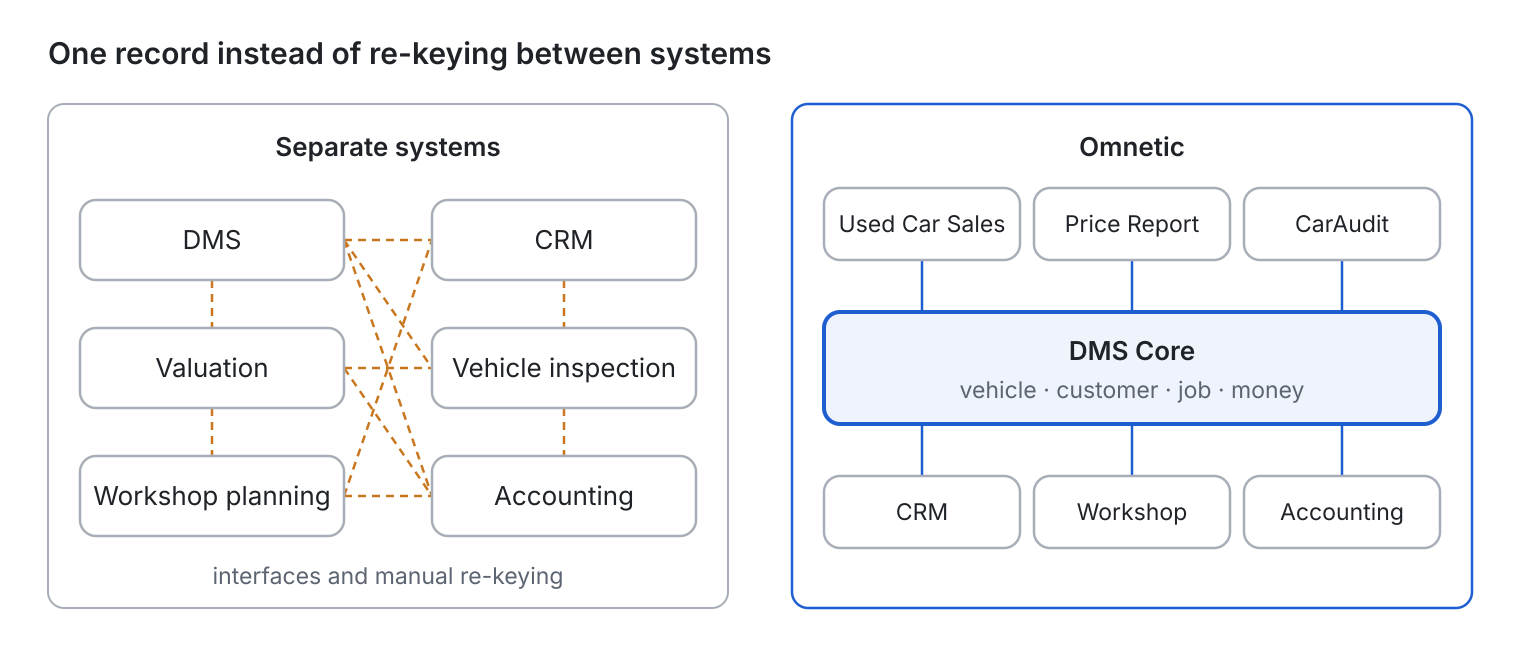
Where the difference shows in day-to-day operations
In a table, the differences look abstract. On an ordinary day at a dealership or workshop, however, they show at every step.
Buying in a used car
A customer comes into the showroom wanting to sell their car or trade it in. In many businesses this means several applications: the inspection report in one, the history check in a second, the price estimate in a third, and entering the car into stock in the DMS. Every re-keying costs time and can introduce errors, for example in the mileage or the equipment.
With Omnetic, a technician goes through the car in the CarAudit mobile app using a configured checklist. They mark damage on a body map with photos, read the VIN from a photo of the VIN plate and record the test drive; the app also works offline. Autotracer uses the VIN to check the car's history in available records, from the mileage history to stolen vehicle registers and insurance claims; the scope of the check depends on what records exist for the car. Price Report uses active listings and completed sales on the market to determine a recommended price and the expected time to sell, and shows a set of comparable cars, with the car's condition from the inspection also feeding into the valuation.
The car is then taken over by Used Car Sales, which manages preparation, advertising, sale and handover through to accounting. Every night, Stock Report goes through the entire used car stock, prioritises the cars that need a decision and suggests a step for each, with a reason, such as repricing or correcting the advert. Approved repricing is pushed to the portals and the website. All steps work with one vehicle record, so data is not re-keyed between them.
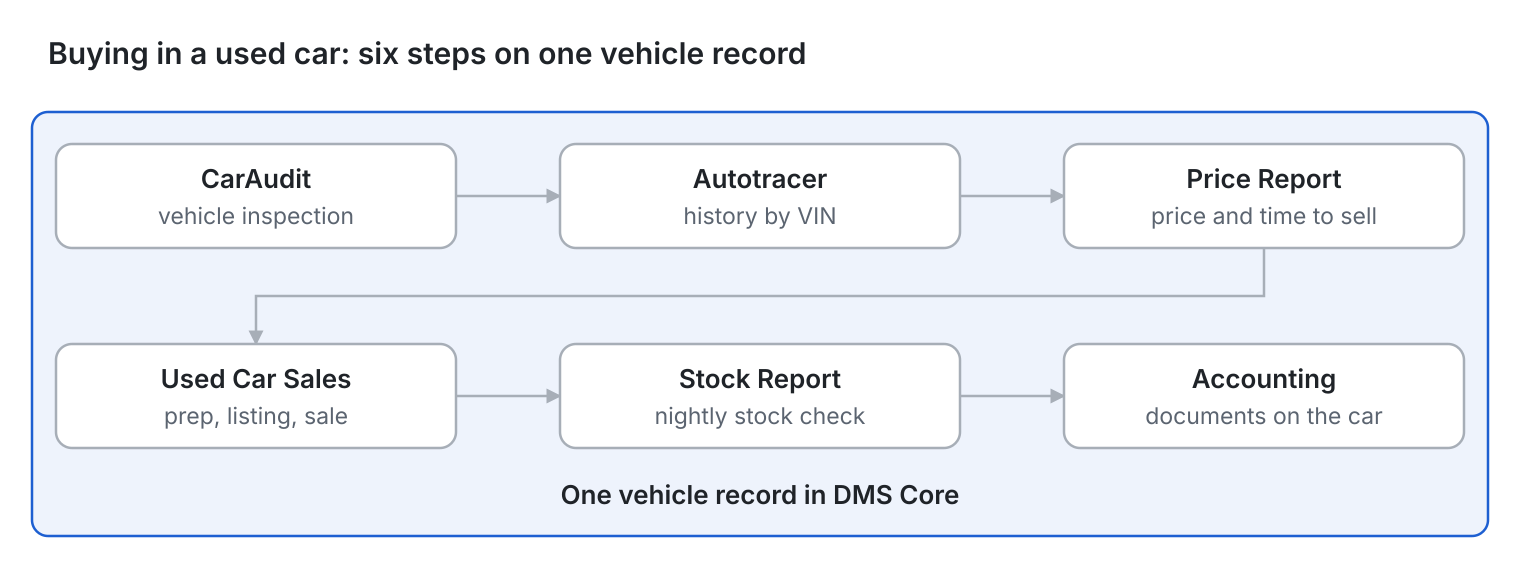
The service job
An ageing car parc means more work for workshops, while mechanics are in short supply: in its 2025 report, the European Labour Authority (ELA) lists motor vehicle mechanics and repairers among the occupations in shortage in 16 European countries, including Germany, Austria, France and the Netherlands. Every technician hour that a workshop plans badly is lost.
The Workshop module manages the service job from the quote through vehicle reception, parts and planning to invoicing, and can split items between the customer, warranty and the insurer. Planner proposes a repair date based on the labour content of the work, the required specialisation and the workshop's actual capacity, assigns work to technicians according to their skills and availability, and adjusts the plan in the event of delays or absences; the workshop foreman has the final say. Warehouse reserves parts for open jobs and releases them when a job is cancelled. Time-keeping records the time worked directly against the job, so it is clear whether the hours sold match the hours worked.
A new brand in the network
In an environment of separate systems, a new branch or brand means further installations, interfaces and data migration. Omnetic runs branches in one cloud platform on the same record of the vehicle, customer, jobs and money; Warehouse, for example, holds the parts stock of several branches on a single stock card. Reporting answers operational and financial questions from the same data the modules work with, and every figure can be drilled down to the source record.
One example is Chery's entry into the Czech market. The importer, Astana Motors Czech, uses Omnetic ERP to manage spare parts distribution, vehicle configuration and logistics, pricing and invoicing for the dealer network. The first Chery dealership, in Průhonice near Prague, uses Omnetic for both sales (CRM) and service (DMS), and the system is being rolled out gradually to other dealers in the network.
Switching to a new system
Replacing a DMS is one of the most demanding decisions the management of a dealership or workshop makes. Fear of operational disruption and of retraining staff is often the reason businesses stay with a system they are not satisfied with. The risk can, however, be reduced.
The first way is a gradual roll-out. Omnetic can be introduced in stages: start with one module, such as Price Report or CarAudit, and add others later. Where DMS Core is already running, switching on Omnetic CRM is a matter of configuration, not a separate project. The second is a clearly defined scope for data migration. When moving to Omnetic, master data and open items are migrated, while closed history remains in a read-only archive. Anyone who wants to keep their own accounting program or other proven tools can connect them via the open platform.
European legislation also helps. Since 12 September 2025, the Data Act has required providers of cloud services, including software as a service, to allow customers to switch to another provider and take their exportable data with them. A contract may not bind the customer to a notice period of more than two months, and from 12 January 2027 providers may no longer charge switching fees. This reflects the situation as of November 2026; in November 2025 the European Commission proposed amendments to the regulation as part of the Digital Omnibus package, so it is advisable to check the details with a lawyer.
Whichever system you choose, it pays to check:
- certified integrations for specific brands in the specific market, because the availability of modules and integrations varies by country and brand with every supplier;
- support for national obligations, such as e-invoicing or tax filings;
- how, and in what format, data can be exported;
- what is migrated during the switch and what remains in the archive;
- who is responsible for the interfaces to other tools, and how many will be needed;
- what working on a tablet looks like at the vehicle, in the workshop and away from the premises.
Omnetic in brief
Omnetic is a software platform for dealerships, dealer groups, workshops and importers. It replaces separate systems, spreadsheets and paperwork with a single cloud platform in which the modules work on a shared record of the vehicle, customer, job and money.
The Omnetic group was founded in 2018 and includes, among others, the brands TEAS, CARIS, JBR and Softvig. It is part of the EAG (European Automotive Group) technology group, which also includes Carvago and CarsData. More than 12,000 business customers from the automotive sector in Europe use the Omnetic group's products and services, and Omnetic manages processes for more than 70 car brands. It is number one in the dealer management system market in Czechia, Slovakia and Poland, and is also established in Germany. In Czechia, it runs the processes of sales and service networks for brands ranging from Toyota and Hyundai to Mercedes-Benz and Ferrari; its customers also include commercial vehicle and truck brands such as Daimler Truck, Iveco and Tatra. For importers, it supplies Omnetic ERP, a central system for vehicle and spare parts distribution, pricing and invoicing of the dealer network.
The offering also includes EAG group services: vehicle purchasing via Carvago BUY™, CarAudit inspections and used car trading via Fastback. The Omnetic BRAIN™ artificial intelligence works inside workflows: it suggests and checks, but acts only within the permissions and approvals set by the customer.
To see how Omnetic would work in your dealership or workshop, you can arrange a demo at omnetic.com.
Related articles
- Average age of cars in Europe: a comparison of EU countries and the impact on servicing and parts
- Workshop planning: how to replan when repairs are delayed, a technician is absent or parts are missing
- Mandatory e-invoicing in the EU: deadlines by country and how dealerships and workshops should prepare, as of November 2026
FAQ
What is a dealer management system (DMS)?
A DMS is the software in which a dealership or workshop manages its vehicles, customers, jobs, parts and money. It connects to manufacturer and importer systems, to banks, insurers and accounting. When it fails, no car can be sold and no service job can be closed.
What should you look for when choosing a DMS?
Offers can be compared against nine requirements: manufacturer and importer integration, one piece of data in one place, the complete used car process, workshop and parts management, accounting and local regulations, work from anywhere, openness, manageable implementation and management overview. Any of the larger suppliers will meet most of them; the difference lies in whether they are met by one system or by a set of systems connected through interfaces.
Which dealer management systems are used in Germany?
The main suppliers include Loco-Soft, which according to its own figures is used by 3,400 businesses; CROSS from Porsche Informatik, which the Volkswagen Group recommended to its dealers; Keyloop; and incadea. Werbas, werwiso from Betzemeier Automotive Software, CarIT from Audev, Nextlane and Cardis Reynolds are also on the market. Omnetic is also an established supplier in Germany.
How do you manage the switch to a new DMS?
A gradual roll-out and a clearly defined scope for data migration reduce the risk. Omnetic can be introduced in stages, for example starting with the Price Report or CarAudit module. Master data and open items are migrated, while closed history remains in a read-only archive.
What does the EU Data Act guarantee when you change supplier?
Cloud service providers must allow customers to switch to another provider and take their exportable data with them. The notice period may not exceed two months, and from 12 January 2027 providers may not charge switching fees. This reflects the situation as of November 2026; the European Commission has proposed amendments to the regulation as part of the Digital Omnibus package.
Sources
- ACEA, new passenger car registrations in the EU, January–April 2026 (Euronews, 27 May 2026)
- ICDP, ranking of the 50 largest European dealer groups (Le Journal de l'Automobile, 18 November 2025)
- KBA, annual registration figures for 2025 (ecomento.de)
- KBA, used car ownership changes in 2025 (AUTOHAUS, 7 January 2026)
- AAA Data, the French used car market in 2025 (Le Journal de l'Automobile)
- ACEA, Vehicles on European Roads 2026
- ELA, EURES Report on labour shortages and surpluses 2025, annex
- AUTOHAUS pulsSchlag, dealer survey on IT and DMS (30 May 2018)
- AUTOHAUS, Praxistag Prozesse 4.0 (22 November 2021)
- ecomento.de, BMW and Volkswagen on the agency model (20 August 2026)
- ZDK, founding of Automotive Mobility Europe
- kfz-betrieb, Loco-Soft has 3,400 user businesses (7 January 2026)
- Loco-Soft, system information
- AUTOHAUS, VW recommends the CROSS DMS to its dealers (29 November 2010)
- Porsche Informatik, CROSS and Retail Solutions
- Porsche Holding, IT systems
- Keyloop, Keyloop DMS and Keyloop Drive
- Keyloop, history and ownership (Wikipedia)
- incadea, incadea Automotive Cloud
- incadea, company information (25 years, 60 manufacturer integrations)
- Solware (incadea partner), incadea selected as BMW's DMS development partner (2 June 2021)
- AUTOHAUS, Kia certifies the Betzemeier DMS (22 September 2023)
- AUTOHAUS, the Moll group switches to CarIT from Audev (11 May 2018)
- AUTOHAUS, interview with Nextlane's head of the DACH region (26 August 2025)
- AUTOHAUS, Cardis Reynolds (11 August 2025)
- AUTOHAUS, DMS integration with Werbas KSR and others (two S advertorial)
- Regulation (EU) 2023/2854 on harmonised rules on fair access to and use of data (Data Act), EUR-Lex
- DLA Piper, switching between providers under the Data Act
- Penningtons Manches Cooper, the Data Act and the Digital Omnibus proposal
- European Commission, adoption of the ViDA package (11 March 2025)