Key findings
- From 18 February 2027, every electric vehicle battery placed on the EU market or put into service for the first time must have an electronic battery passport (Article 77 of Regulation (EU) 2023/1542). The date the car is registered or sold is irrelevant.
- Batteries placed on the EU market before this date do not need a passport retrospectively, even when a dealer buys the car in and sells it again. The obligation arises for them only on remanufacturing.
- The public part of the passport contains the chemistry, rated capacity, voltage, expected lifetime and the period of the commercial warranty. Data on the battery's state of health, cycles, negative events and dismantling can be seen only by persons with a legitimate interest.
- The economic operator placing the battery on the market is responsible for the passport. A dealer that simply resells the car does not have this responsibility. A routine battery repair does not require a new passport.
- As of November 2026, Regulation 2026/1778 on the digital passport registry and Decision 2026/1736 with six harmonised standards have been published. The act on access to the restricted passport data is still being prepared.
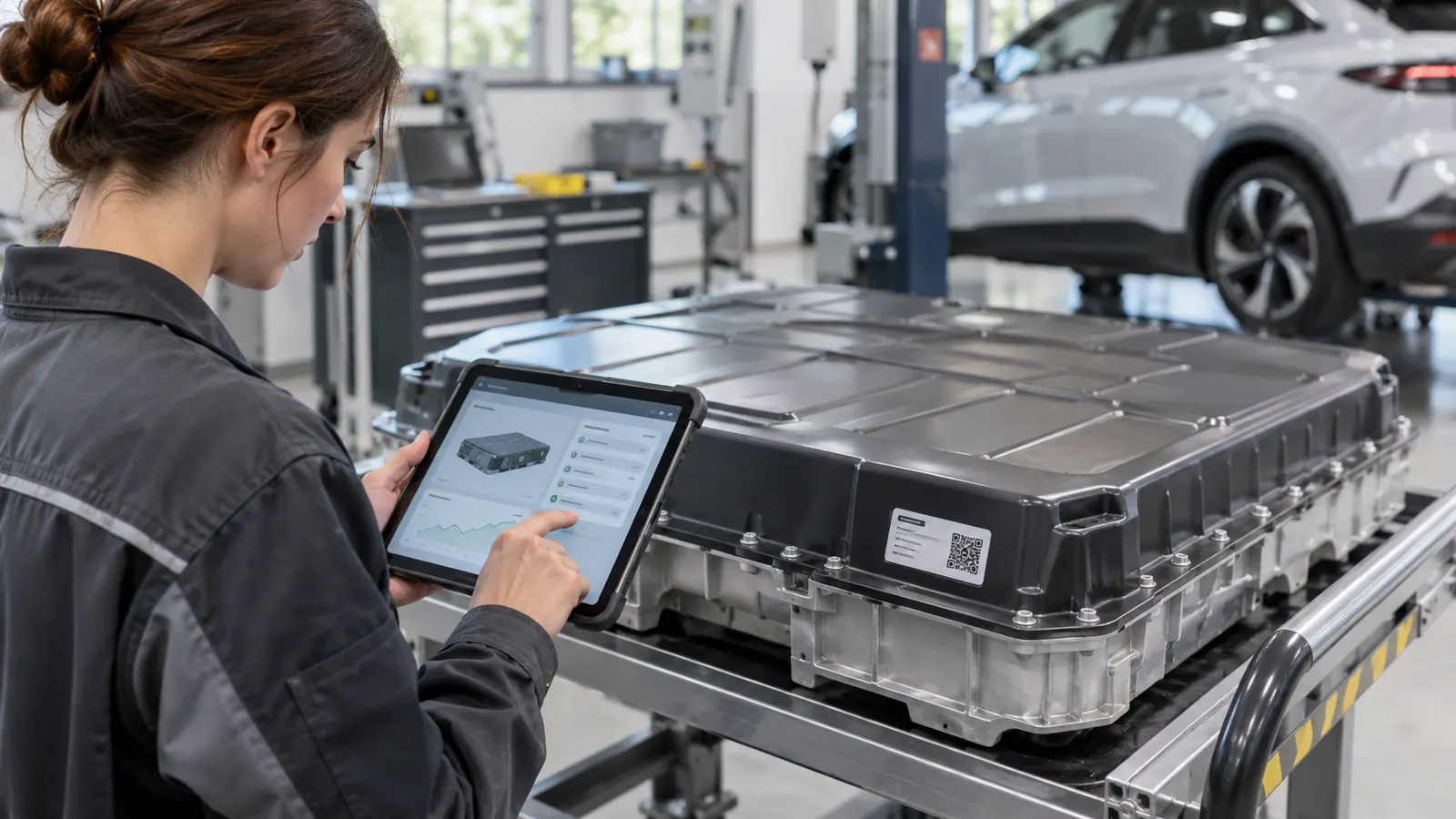
The battery passport is an electronic record for a specific traction battery, introduced by the EU Batteries Regulation. It contains the battery's technical data and information about its subsequent life: its state of health, repairs, remanufacturing, repurposing and recycling. For dealerships and workshops, this raises two questions. Who has to provide the passport? And how should its data be used in buying in, sales and the workshop? Some of the rules already apply, the main obligation starts in February 2027, and the details of access to the data are still being worked out as of November 2026.
When the battery passport becomes mandatory and which batteries it covers
Article 77 of Regulation (EU) 2023/1542 sets the start of the obligation at 18 February 2027. The obligation applies to every individual battery placed on the EU market or put into service for the first time from that date.
| Battery category | Scope of the obligation from 18 February 2027 |
|---|---|
| Electric vehicle batteries | every battery |
| LMT batteries (light means of transport) | every battery |
| Industrial batteries | batteries with a capacity above 2 kWh |
For dealers and workshops, the first group is what matters. The 2 kWh threshold applies only to industrial batteries. There is no capacity threshold for electric vehicle traction batteries.
An electric vehicle battery passport belongs to the specific battery, not to the car. The VIN is therefore no substitute for it. When the battery is replaced, the car stays the same, but the passport changes with the battery.
For stock, what counts is the battery being placed on the market for the first time, not registration of the car
The obligation is tied to the moment the battery is first placed on the EU market or put into service. Manufacture of the battery, receipt of the car at a branch, registration and sale to the end customer are different events. Stock therefore cannot be divided simply by registration date. For cars delivered around February 2027, the documentation from the manufacturer, importer or supplier will be decisive.
| Situation at the dealership | What follows from it |
|---|---|
| A new car is sold after the deadline, but its battery was placed on the EU market before the deadline | the later sale does not create an obligation to create a passport retrospectively |
| The battery of a new car is placed on the EU market for the first time on or after the deadline | it must have a passport |
| A dealer buys in a used car with a battery placed on the EU market before the deadline, including in another EU country | neither buying it in nor reselling it requires a passport |
| An older car with a battery is placed on the EU market for the first time only on or after the deadline | the car's age does not exempt it from the obligation |
Information on whether the battery has a passport, together with the supplier's documentation, is therefore best kept directly on the vehicle record. In Omnetic, all modules, from purchasing through Used Car Sales to the workshop, work with a single shared vehicle record in DMS Core. Data entered when the car is received into stock is thus visible to sales and the workshop, and nobody has to re-key it.
What the digital battery passport contains and who can see the data
Annex XIII of the Regulation divides the content of the passport according to access rights. Opening a passport does not automatically show everything.
| Information layer | Content | Access |
|---|---|---|
| Public data | chemistry, rated capacity, voltage, expected lifetime, period of the commercial warranty | anyone |
| Technical information | details needed to dismantle the battery | persons with a legitimate interest |
| Individual operating data | state of health, usage cycles, negative events | persons with a legitimate interest |
For a salesperson, the public part is useful for identifying and describing the battery in a listing. For a repair or a decision on the battery's further use, the workshop also needs the restricted data. So a piece of data may be stored in the passport and still be invisible to an ordinary visitor.
As of November 2026, the Commission is still preparing the act that will specify in detail the authorised persons and their access. Workshop procedures therefore cannot yet assume that every technician will be able to obtain all the data from the passport.
Battery state of health: data in the battery management system has been mandatory since 2024
Article 14 of the Batteries Regulation has applied since 18 August 2024. The battery management system of an electric vehicle must store up-to-date parameters on the battery's state of health and expected lifetime. A person who has legally purchased the battery, or any third party acting on their behalf, must have non-discriminatory read-only access to them.
This is a separate obligation, independent of the passport. This data can already be used today. It does not mean, however, that an older car must have an electronic passport.
When buying in and at workshop check-in, record not only the state of health value but also the date of the reading and how the technician obtained it. A number on its own is weak evidence for a valuation, a warranty claim or a repair decision. The reading can be an item on the checklist that CarAudit guides the technician through during the vehicle inspection. The report with photos and findings is saved to the vehicle record in DMS Core, and the car's condition feeds into the valuation in the Price Report module.
Who is responsible for the passport and how it is updated
The economic operator placing the battery on the market is responsible for ensuring the passport is accurate, complete and up to date. It may mandate another operator in writing to carry out the relevant tasks.
A dealer that takes a car from the distribution network and resells it therefore neither creates nor manages the passport. The situation is different when a business places the battery on the EU market for the first time, for example through its own imports. The same applies when it places the battery on the market again after remanufacturing or repurposing.
In a dealer group, it is therefore a good idea to separate responsibility for the car deal from responsibility for the passport. The service advisor should know whom to report a mismatch in the battery identification or missing data to. However, they do not take over management of the passport just because they are handling the job.
According to the European Commission's interpretation, the dynamic data in the passport must be updated at least whenever the battery's status changes in its life cycle. An update is also required when such a change is being assessed, that is, when deciding on remanufacturing, repurposing or recycling. The passport therefore does not continuously transmit all the operating data from the car.
What happens on repair, remanufacturing and repurposing
| Intervention | Consequence for the passport |
|---|---|
| Routine battery repair | according to the Commission's interpretation, no new passport is created |
| Remanufacturing from 18 February 2027 | the passport obligation arises even for a battery placed on the market before the deadline; the new passport is linked to the previous one if it existed |
| Repurposing the battery | the new passport is linked to the previous passport |
The workshop documentation must make it clear whether the work was a repair, remanufacturing or repurposing. The commercial name of the service is not enough. The description must include the work carried out, the identity of the battery and the operator taking responsibility for placing it on the market again. The Workshop module manages the service job from vehicle check-in through parts and planning to invoicing. It splits the lines between the customer, warranty and the insurer, so the description of the work and its payment stay on one job and one vehicle record.
What to prepare in buying in, sales and the workshop
Separate spreadsheets at individual branches increase the risk that the link between the battery, the reading of its state of health and the repair carried out will be lost when the car is handed over. Preparation therefore starts with dividing roles and keeping uniform records.
- Purchasing and receipt into stock: record whether the battery is subject to the passport obligation and attach evidence of when it was first placed on the market. For a battery with a passport, also record its identifier.
- Buying in a used car: keep the battery identification, the passport data and the inspection findings separate. Each of these answers a different question.
- Sales and handover: describe the battery actually fitted in the car. After a battery replacement, the description in the advert and the offer changes.
- Workshop check-in: link the job to the battery's identity, the date of the state of health reading and the fault description.
- Battery repairs: determine who records the work and who passes the data to the operator responsible for the passport when an update is required.
- Remanufacturing and repurposing: settle responsibility for the new passport and its link to the previous record before the battery goes back on the market.
What already applies, what is in preparation and what is left to member states
| Area | Status as of November 2026 | Impact on operations |
|---|---|---|
| State of health and lifetime data in the battery management system (Art. 14) | applies since 18 August 2024 | the data can already be used now |
| Battery passport obligation (Art. 77) | adopted, applies from 18 February 2027 | prepare a way to distinguish batteries, responsibilities and records |
| Digital passport registry | Regulation 2026/1778 published | the registry has a legal basis |
| Harmonised standards | six standards published by Decision 2026/1736 | the technical solution for the passport has published standards |
| Access to restricted passport data | the Commission is still preparing the act | workshops' access rights are not yet settled |
| Market surveillance and penalties | a member state competence | supervisory authorities and penalties vary by country |
The Regulation applies directly in all member states, so states do not postpone or change the 18 February 2027 date. The missing access act does not change this date either.
Watch out
Confusing the sale of a car with the battery being placed on the market for the first time. This leads to cars in stock being labelled incorrectly. A business may thus overlook the obligation for a battery that it places on the EU market for the first time itself, for example when importing from a third country.
The passport as the car's service history. The passport describes the battery. Workshop jobs, warranty decisions and vehicle documents need their own records.
Promising full access to all repairers. The public and restricted parts of the passport are subject to different regimes, and the details of authorised access are still being prepared.
Every repair labelled as remanufacturing, or vice versa. A routine repair does not require a new passport. However, incorrectly classified work can hide a situation in which a new passport must be created.
Omnetic: a single vehicle record for buying in, sales and servicing electric cars
With an electric car, more documents are linked to a single vehicle than with a combustion-engined car. They include the battery's identity, passport information, battery state of health readings and repair records. When buying in, sales and the workshop each keep them in their own system, the link is easily lost when the battery is replaced or the car is transferred between branches. Omnetic replaces these separate systems, spreadsheets and paperwork with a single cloud platform.
- DMS Core holds a single shared record of the vehicle, customer, jobs and money that all modules work with. Battery data entered at purchase is therefore visible to sales and the workshop without re-keying.
- CarAudit guides the technician through a configured checklist when buying in or checking stock, works online and offline, and saves the report with photos to the vehicle record. Findings can be turned into reconditioning tasks.
- Workshop manages the service job from quotation through vehicle check-in, parts and planning to invoicing. It splits the lines between the customer, warranty and the insurer.
Existing systems, such as the manufacturer's portal or accounting software, connect to Omnetic via the open platform with APIs, webhooks and manufacturer integrations. It can be introduced gradually, starting with the CarAudit module, for example.
Book an Omnetic demo and walk through an electric car's journey from buying in through reconditioning to the workshop job.
Related articles
- Euro 7 from 29 November 2026: what changes for car dealers and workshops
- Electric cars in the EU car parc: shares of BEVs and hybrids and the changes for workshops
- Qualifications for working on electric vehicles: what regulations require in EU countries
FAQ
Does the battery passport replace diagnostics and repair information for the car?
No. The passport contains information about the battery. Independent operators' access to the vehicle's diagnostic data, tools and repair and maintenance information is governed separately by Article 61 of Regulation (EU) 2018/858.
Is the battery passport a guarantee of the battery's technical condition?
No. The passport is an information record. It states the period of the commercial warranty and data on the battery's state of health, but it does not itself provide any warranty and does not replace diagnostics when there is a fault.
Does a replacement battery fitted under warranty need a passport?
Yes, if the replacement battery is placed on the EU market for the first time on or after 18 February 2027. The obligation is tied to the battery, not to the age of the car. The workshop then keeps the history of the original battery in the job and links the car to the identity of the new one.
How is the battery passport related to the Euro 7 standard?
They are two separate pieces of legislation. Euro 7 (Regulation (EU) 2024/1257) applies from 29 November 2026 to new types of passenger cars and light commercial vehicles and requires manufacturers to make the vehicle's environmental data, including the state of health of the traction battery, available to users. It is a type-approval requirement for the vehicle. The battery passport is a record of the battery under the Batteries Regulation. Euro 7 is covered in detail in a separate article.
Sources
- https://eur-lex.europa.eu/eli/reg/2023/1542/oj
- https://single-market-economy.ec.europa.eu/single-market/digital-product-passport/eu-digital-product-passport-faq-batteries_en
- https://eur-lex.europa.eu/eli/dec_impl/2026/1736/oj
- https://eur-lex.europa.eu/eli/reg/2018/858/oj
- https://eur-lex.europa.eu/eli/reg/2024/1257/oj
- https://www.omnetic.com/
- https://www.omnetic.com/dms-core
- https://www.omnetic.com/caraudit
- https://www.omnetic.com/price-report
- https://www.omnetic.com/workshop
- https://www.omnetic.com/faq