Key findings
- First identify the obstacle: a technician, a workstation, a part or customer approval. Only then allocate new times. Changes are managed by one person, usually the workshop foreman.
- Calculate the remaining capacity from the technicians present and what is left of their shift. Then narrow it down by skills and equipment. High-voltage work can only be taken over by a technician with the relevant qualification.
- For a job in progress, reschedule only the remaining operations, including the final check and handover. Fill the freed-up slot with jobs that have their parts and an approved scope.
- Contingency for urgent repairs and the preparation of used cars for sale have their own capacity in the plan; they are not managed outside it.
- When a repair is delayed, a technician is absent or a job changes, Planner in Omnetic continuously adjusts the plan according to technicians' skills, workshop capacity and parts availability. The final decision rests with the workshop foreman.
Replanning the workshop means reallocating work as soon as the original plan no longer reflects what is happening on the shop floor. A delayed diagnosis can tie up a specialist, a missing part can block a lift and a technician's absence can affect several other jobs. Moving a single booking in the diary is therefore not enough. The service manager has to restore a workable plan for the entire affected part of the workshop and align it with reception, the parts department and car sales. The faster this is done, the fewer hours technicians spend waiting. That is why good workshop planning assumes from the outset that the plan will change during the day.
Workshop planning: what the plan must contain
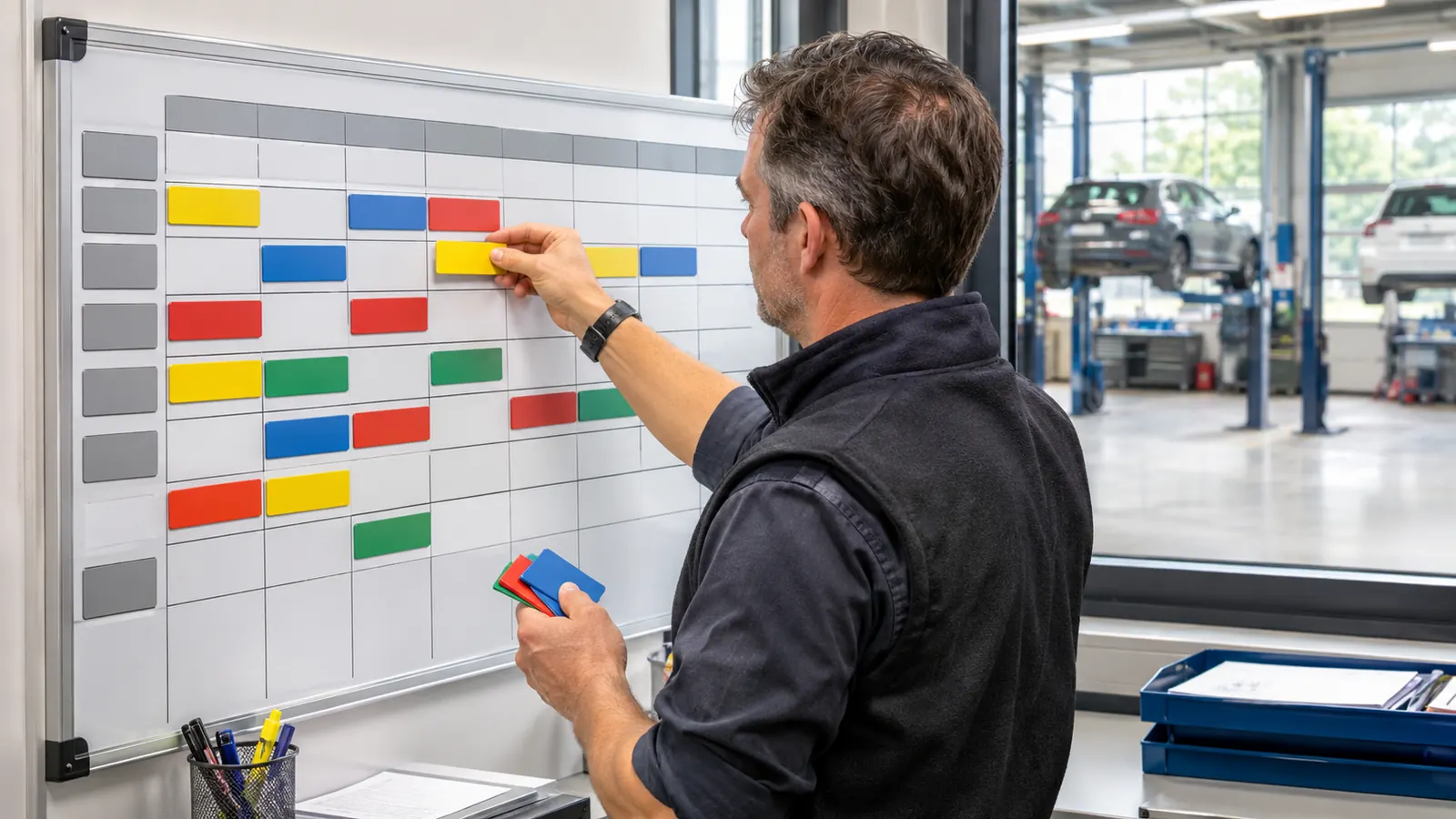
The basic unit of the plan is a task assigned to a technician and a workstation. A booking that just says "car in for service" does not show whether the job needs diagnostics, a mechanical repair, an external service or a final inspection. When something goes wrong, it is then unclear which part can be moved and which must stay with the original technician. That is why even the manual planning boards used by some German dealerships assign a technician and a time to every job.
For every open job, at least the following must be visible:
| Information | What it is used for when the plan changes |
|---|---|
| Remaining operations and their dependencies | Shows what can be started independently and what is waiting for previous work to be completed |
| Estimate of remaining time | Helps find a slot for completion without counting finished work again |
| Assigned technician and required skills | Prevents work being moved to someone who cannot take it over |
| Workstation and equipment | Reveals clashes between jobs that need the same lift or diagnostic equipment |
| Status of parts and work approval | Separates jobs that can go ahead from those still waiting |
| Promised handover time | Shows which commitments the change puts at risk |
| Condition of the car | Distinguishes a driveable car from a dismantled one that cannot simply be parked |
Standard hours are not the same as the time a car spends in the workshop. Between operations there may be waiting for a delivery, an external service or a reply from the customer. Besides the labour content, the plan therefore also needs the sequence of operations and time constraints. For diagnostics and unusual repairs for which no standard times exist, planning is based on an estimate from experience. This is refined as soon as the fault is known.
In its Planner module, Omnetic links the labour content of the work, technicians' specialisations, the workshop's actual capacity and the availability of parts in stock. When there is a delay or absence, it continuously adjusts the plan, but the workshop foreman decides what the plan looks like.
How to start replanning the workshop
The change is managed by one person, usually the foreman or workshop manager. The service advisor provides the customer commitments, the parts department information on parts and the technicians the status of work in progress. When everyone moves their own part, conflicting times arise.
1. Identify the obstacle and its impact
A note saying "job delayed" is not enough. Useful information looks like this, for example: diagnostics is ongoing and the repair cannot yet be determined; the technician is not coming in today; the correct part is not on site.
Every obstacle has a responsible person and a time for the next update. The parts department secures confirmation of the delivery, the advisor obtains the customer's approval and the foreman finds a replacement technician. Removing the obstacle is thus handled separately from moving the job itself.
2. Recalculate the remaining capacity
Planned attendance in hours is the number of days present multiplied by the daily working hours. If someone drops out during the day, count only the technicians present and the remaining part of their shift. Deduct work already committed and time when the technician is not working on jobs. Then narrow the result down by skills and equipment.
Illustrative example: a workshop with six technicians and an eight-hour shift has 48 hours of planned attendance. If one technician falls ill, 40 hours remain. If they were the only one qualified for high-voltage work, nobody else will take over their job on a hybrid car, even if the others have free time in the plan.
A free mechanic therefore cannot always stand in for a missing diagnostic technician. Any reassignment must match the technician's competence and the workshop's rules.
3. Separate work that is ready from jobs that are waiting
A freed-up slot should be filled with work for which the car, an approved scope, parts and equipment are all available. A job with an unconfirmed delivery can stay in the outlook, but it must not take up the same capacity as work ready to start.
It pays to distinguish between the statuses "ready", "in progress" and "waiting". A waiting job must always show a reason, otherwise the foreman keeps having to find out why nobody is working on the car.
4. Move the entire chain of follow-on work
A repair is often followed by wheel alignment, calibration, a road test or an inspection. If only the main operation is moved, the final completion time remains unrealistic.
The new plan must therefore extend right up to the point when the car is ready for handover. It must also take into account the availability of the person carrying out the final operations and the date of any external service.
5. Confirm the change and set the next decision point
The technician needs to know what to continue with. The advisor needs a new time, or clear information about why one cannot be promised yet. The parts department must know about changed dependencies that affect the preparation of parts.
Tie the next update to an event: completion of diagnostics, confirmation of a delivery or a replacement technician taking over the work. Replanning must not end with the job left in an undefined "later" status.
What to change when a repair is delayed, a technician is absent or a part is missing
Each cause requires a different response. Postponing all jobs across the board shifts the problem to places where work could carry on.
| Shop-floor situation | Immediate action | What can continue | Impact on the completion time |
|---|---|---|---|
| Diagnostics runs over and the scope of the repair is unknown | Separate continued diagnostics from the repair not yet defined | Other work that is ready and does not require the same specialist | Confirm the repair time only once the scope and dependencies are known |
| A technician is absent from the start of the shift | Distribute their jobs according to the skills of the stand-ins | Work for which a suitable technician and a free workstation are available | Mainly reschedule operations for which there is no qualified replacement |
| A part is missing after dismantling | Decide whether the car can be safely parked and find out the confirmed delivery status | Independent operations on the same car or another job that is ready | Tie completion to the part and the remaining work, not just to its delivery |
| Sales wants a used car prepared earlier | Compare the requested date with confirmed service commitments | Preparation that fits within capacity and does not push back higher-priority work | Any new promise made by sales must first go through the workshop plan |
When a repair runs over
Distinguish whether additional work has been found or the original operation is taking longer. An additional fault changes the scope of the job; a technical problem during the work changes the estimated completion. In both cases, the plan needs the current volume of remaining work.
Do not hand over a complex operation in progress to another technician just because they are free. A handover requires a description of the steps carried out, measurement results, dismantled parts and the next steps. Repeating diagnostics or searching for parts that have been set aside can make the reassignment take longer.
When a technician drops out
First separate the work that another team member can take over from the operations tied to the missing specialisation. For example, a stand-in can complete routine maintenance while a specialised diagnostic task waits.
Taking over work in progress also includes familiarising oneself with the condition of the car, so the capacity of the others must not be used up only on paper. For safety-critical operations, it must be clear who will check the completed work.
When a part is missing
Distinguish between a part on order, a confirmed delivery and a part physically ready for the job. An expected delivery is not a fixed start for fitting.
For a dismantled car, the technician decides whether the workstation can be safely freed up. Moving the car at all costs may require temporary reassembly and repeating work later. If the car stays on the lift, the plan continues to treat the workstation as occupied, even if the technician is working elsewhere.
Which jobs take priority?
Priority goes to safely completing an operation in progress and to work that is ready with a firm customer commitment. Among comparable jobs, first complete the one that frees up an occupied workstation and allows the car to be handed over. How loudly reception or sales press for a job is not a priority rule.
Preparing cars for sale has its own place in the plan. It requires technicians, parts and workstations just like a customer repair. If it is managed outside the plan as "internal work", the workshop is in reality busier than the diary shows. Sales specifies the scope of preparation and the required handover date, and the foreman allocates capacity accordingly. Some dealers set the priority of used cars in advance as a fixed rule for allocating workshop jobs. Urgent used-car preparation therefore does not become an invisible job that gradually pushes customers back.
The basic plan should also include a time buffer for urgent repairs and dedicated capacity for express service. Derive the size of the buffer from operational experience and the job mix. If the buffer is repeatedly filled in advance, the only option left at the next disruption is to move promised times.
How to tell the customer about the change
The service advisor contacts the customer as soon as the change puts the agreed handover at risk. The message includes the reason, the impact and the next step. Internal job reshuffles do not need to be explained to the customer.
If a parts delivery has not been confirmed, the message might read:
"The repair is waiting for a replacement part, so we will not be able to meet the original handover time. As soon as the parts department confirms the delivery, we will schedule the remaining work and let you know the new time. You will hear from us again today before closing time."
A promise of a further update must have a responsible person. Even a message that nothing has changed is better than a missed contact. If additional work is added or the price changes, the customer must approve it separately. A new completion time does not replace this approval.
Pitfalls when replanning the workshop
Typical causes of declining workshop performance include missing parts, rework and unnecessary interruptions. All three arise mainly from poorly managed replanning. How to measure lost hours is covered in a separate article on workshop productivity.
- Moving the whole job without splitting it into operations. This obscures both completed work and parts that could continue.
- Planning by headcount. This overlooks specialisations, occupied workstations and shared equipment.
- Starting a repair without the parts ready. This turns a driveable car into an obstacle on the workstation.
- Repeatedly interrupting technicians. This adds handovers and returns to unfinished work.
- Overtime as the first response. It neither replaces a missing part nor makes up for a lack of qualified staff.
- Several versions of the plan. The board, the spreadsheet and the advisors' notes diverge. The plan needs one authoritative place and one person managing changes.
Omnetic links plan changes with the service job and parts
In many workshops, the planning board, jobs and the parts department run separately. Every change then has to be transferred to several places by hand. In Omnetic, all modules work with one shared record of the car, customer, job and money in DMS Core, so data is not re-keyed between them.
- Planner proposes an appointment based on the labour content of the work, the required specialisation and the workshop's actual capacity. It sequences tasks according to their dependencies, assigns them to technicians according to skills and availability, and continuously adjusts the plan when there is a delay, an absence or a change to the job. It also takes into account the availability of parts in stock and the preparation of cars for sale. The workshop foreman can change the plan at any time.
- Workshop manages the service job from the quote through vehicle reception, parts and planning to invoicing. The new time is therefore part of the same job the service advisor works with.
- Warehouse reserves parts for open service jobs and releases them when a job is changed or cancelled. A part therefore does not sit blocked for a car that has been moved to another day.
You can arrange an Omnetic demo focused on replanning the workshop when a technician drops out, a repair is delayed or a job is waiting for a part.
Related articles
- Vehicle check-in at the workshop: active reception, walkaround with the customer and condition report
- Workshop productivity: how to measure utilisation, efficiency and lost hours
- Parts stock: how to identify non-moving parts and release tied-up capital
FAQ
What should be done if the customer does not bring the car in?
Mark the job as a no-show and release its capacity for work that is ready. The service advisor agrees a new date with the customer. The original booking must no longer block the technician or the workstation.
Can diagnostics be booked without reserving the subsequent repair?
Yes. For an unclear fault, it is better to separate diagnostics from a repair whose scope is not yet known. The customer should know in advance whether they are getting an appointment to identify the fault or a commitment to complete the whole repair.
What should be done if the planning system goes down?
Keep a single temporary overview with the job, technician, workstation and current status. One designated person records changes in it. Once the system is back up, transfer the changed times and allocation of work into it as well, otherwise two different versions of the plan will exist.
Should the original plan be restored when the technician returns?
Not across the board. Colleagues may already have taken over part of their work, and other jobs have been given new times in the meantime. Allocate work to the returning technician according to the current situation to avoid further unnecessary handovers.
Sources
- https://www.kfz-betrieb.vogel.de/autohaus-zellmann-staerkt-kundenloyalitaet-a-557648/
- https://m.u-form-shop.de/%24WS/u-form/websale8_shop-u-form/produkte/medien/pdf/2331.pdf
- https://media1.autohaus.de/fm/3478/bkp-Kremer-Zukunftsforum.pdf.pdf
- https://www.heimbrock-winkler.de/top_info_automotive/artikel/werkstatt_wirtschaftlich_steuern_diese_kennzahlen_entscheiden_ueber_den_ertrag_im_aftersales_e9071/
- https://www.omnetic.com/planner
- https://www.omnetic.com/workshop
- https://www.omnetic.com/warehouse
- https://www.omnetic.com/dms-core